

Call 801-233-1564
Serving Salt Lake • Ogden • Provo • Park City
Licensed Contractor

A water heater install is one of the most impactful home projects you can take on — and one of the most misunderstood. Here's a quick overview before we dive in:
Quick Answer: How Does a Water Heater Install Work?
Typical costs at a glance:
| Water Heater Type | Average Install Cost |
|---|---|
| Electric tank | $920 – $1,177 |
| Gas tank | ~$2,607 |
| Tankless | $960 – $3,910 |
| Heat pump / hybrid | $1,250 – $3,600 |
| Solar | $2,000 – $7,500 |
Whether your current unit just gave out on a cold Utah morning or you're planning ahead, this guide walks you through everything — costs, steps, permits, safety, and maintenance — so you know exactly what to expect.
At iRepair Heating and Air, we've handled hundreds of water heater install projects across Salt Lake City and the Wasatch Front, from straightforward tank swaps to full tankless conversions. That hands-on experience shapes every recommendation in this guide.
Planning a water heater install requires balancing upfront budgets with long-term operating costs. While it is tempting to simply buy the cheapest model available when your current unit fails, taking a step back to evaluate your options can save you thousands of dollars over the lifetime of the appliance.
Generally, the average cost for water heater installation ranges between $1,600 and $5,800, depending heavily on the technology, fuel source, and complexity of the setup. For example, a basic electric water heater installation typically costs between $920 and $1,177, making it one of the most budget-friendly entry points. On average, gas water heater installation costs around $2,607, reflecting the additional complexity of gas line connections and venting.
If you are looking at capacity, size is a major price driver:
Before committing to a brand-new unit, it is wise to determine whether your existing system is truly beyond saving. Check out The Great Debate: Navigating Water Heater Repair vs Replacement to weigh your options. If replacement is the clear path forward, understanding the full financial landscape is your next step. You can read our comprehensive pricing resource, The Ultimate Breakdown of Water Heater Replacement Costs, to budget with confidence.
Choosing the right technology is the most critical decision in your installation journey. Traditional storage tanks keep 40 to 80 gallons of water hot 24/7, which leads to standby heat loss. Tankless water heaters, on the other hand, eliminate standby heat loss entirely by heating water instantly as it passes through a high-powered heat exchanger.
In fact, tankless water heaters can be up to 34 percent more energy efficient than a traditional water heater for households that use 41 gallons or less of hot water daily. Brands like Rinnai tankless water heaters have a longer lifespan than standard water heaters, often lasting 20+ years compared to the 8 to 12 years expected from a traditional tank.
Hybrid heat pump water heaters pull heat from the surrounding air and transfer it to the water. This makes them incredibly efficient, though they require specific clearance space and warm ambient air to operate optimally.
| System Type | Average Lifespan | Energy Efficiency | Upfront Install Cost | Key Benefit |
|---|---|---|---|---|
| Traditional Tank | 8 – 12 Years | Moderate (~60%) | Lower ($1,000 – $2,500) | Low initial cost; simple install |
| Tankless | 20+ Years | High (Up to 98%) | Moderate to High ($960 – $3,910) | Endless hot water; space saver |
| Hybrid Heat Pump | 10 – 15 Years | Very High | Moderate ($1,250 – $3,600) | Drastically cuts electricity bills |
If you are considering switching to an on-demand system, our team at iRepair Heating and Air consists of the Local Experts for Tankless Service and Replacement in Utah who can help you determine if your electrical panel or gas lines can support the upgrade.
Sizing a water heater is not just about choosing a tank capacity; it is about calculating your household's peak hot water demand. For tank systems, look at the First Hour Rating (FHR), which measures how many gallons of hot water the unit can deliver in its first hour of operation starting with a fully heated tank.
For tankless systems, sizing is calculated in Gallons Per Minute (GPM). To size a tankless heater:
Solar water heaters use roof-mounted solar collectors to absorb solar energy, transferring that heat directly to your water supply. Because they rely on the sun, they are paired with a backup gas or electric tank to ensure you still have hot water during cloudy winter days.
Heat Pump Water Heaters (HPWHs) integrate highly efficient refrigeration technology with standard thermal storage. Most current Heat Pump Water Heaters come in either 6- or 10-year limited equipment warranties.
For homes with restricted space, split-system HPWHs are an excellent option. They allow the tank to be placed in a confined indoor closet while the heat pump compressor sits outdoors, eliminating the need for large indoor air volumes and venting.
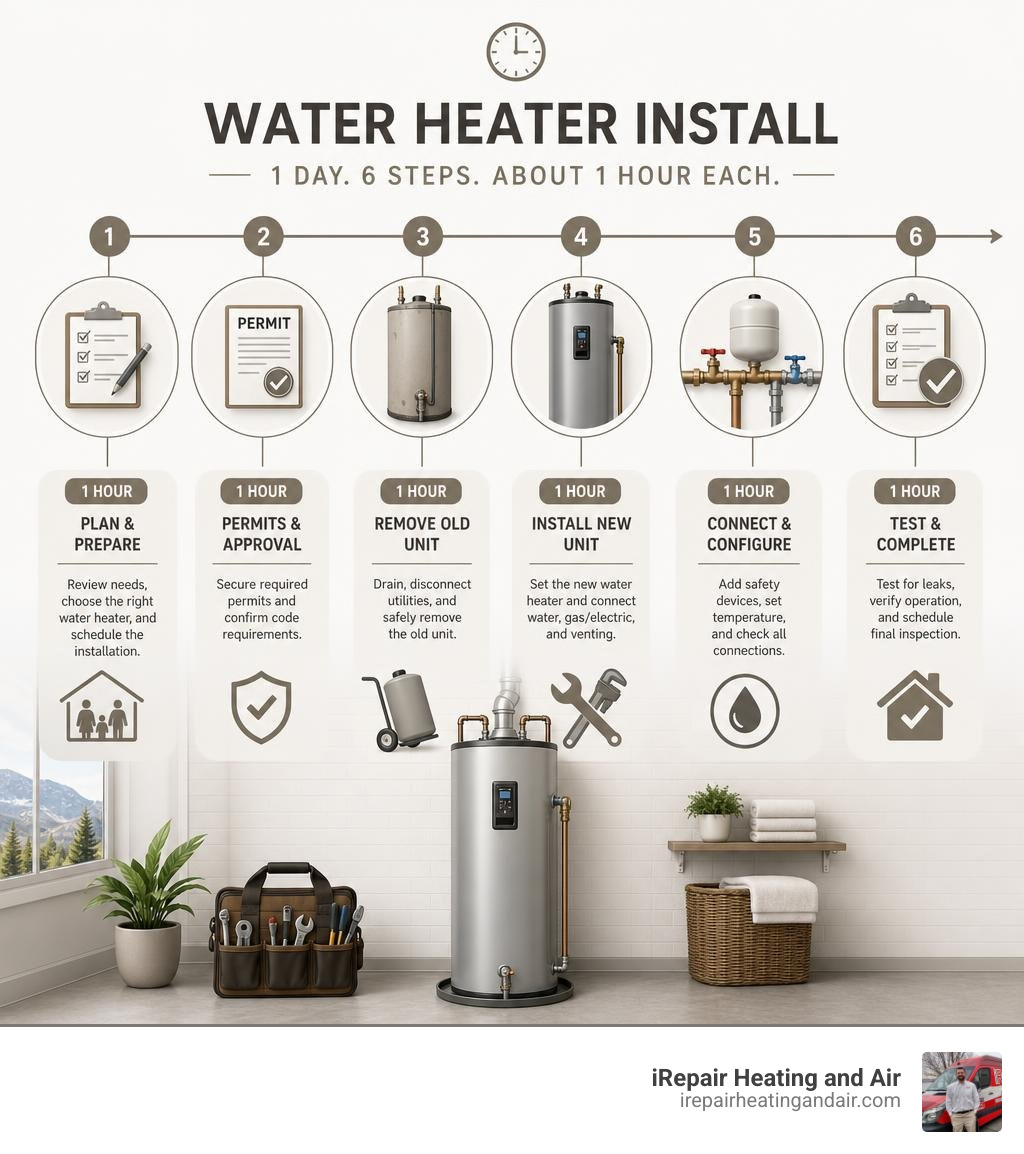
Installing a water heater is a highly technical task that involves high voltage, pressurized water, and potentially explosive gas. Below is an overview of how we execute a standard installation safely and efficiently.
A standard tank installation requires careful preparation and adherence to manufacturer instructions. For reference on general product specifications, you can consult the official Rheem Water Heaters documentation.
The installation path diverges significantly when comparing a standard tank to a tankless system. A tankless unit is wall-mounted, saving roughly 9 square feet of floor space. However, its utility demands are much higher.
While a standard 50-gallon gas tank requires about 40,000 BTUs of gas, a tankless unit can require up to 180,000 BTUs. This often means we must run a larger gas line from your meter to the unit.
Venting is also entirely different. Standard tanks use atmospheric draft hoods venting into a metal chimney. High-efficiency condensing tankless systems use sealed combustion, pulling outdoor air and venting exhaust through specialized PVC or polypropylene pipes. For detailed manufacturer venting guidelines, refer to the Rheem Owner’s Guide Installation Instructions .
In Utah, water heater installations are strictly regulated by local building codes to protect your home from fire, gas leaks, water damage, and carbon monoxide poisoning.
Yes, you need a permit for a water heater install along the Wasatch Front. Municipalities like Salt Lake City, Sandy, Ogden, and Provo require a permit and a subsequent inspection to verify that the installation complies with the International Residential Code (IRC).
A professional contractor will always pull these permits on your behalf and handle the paperwork. During an inspection, the city inspector will verify proper venting, gas line sizing, sediment traps, seismic strapping, and drainage. For an example of what municipal inspectors look for, you can review the Boise Microsoft Word - #420-A Water Heater Install GuideJune 2025Final as a solid general framework of standard municipal inspection expectations.
Every water heater installation must include key safety components to prevent catastrophic system failures:
For technical details on pressure limitations and closed-system safety, consult the Product Manual for indirect-fired and commercial-grade systems.
Once your water heater is installed, keeping up with basic maintenance will maximize its lifespan, lower your energy bills, and preserve your manufacturer's warranty.
Over time, minerals in Utah’s water settle to the bottom of your tank, creating a thick layer of sediment. This sediment acts as an insulator, forcing the burner or heating elements to work much harder to heat the water, which can cause the tank bottom to overheat and eventually crack.
To maintain your tank system:
To perform these tasks safely, follow our detailed guide on How to Maintain Your Water Heater Tank Without Getting Burned. If you prefer to leave it to the professionals, we offer The Best Water Heater Maintenance Services in Sandy and surrounding Utah communities.
Tankless systems do not suffer from tank sediment, but they are highly sensitive to hard water scale. Calcium and magnesium can bake onto the heat exchanger, reducing efficiency and eventually causing system failure.
To prevent this, you should flush your tankless system annually with food-grade white vinegar to dissolve mineral scale. Additionally, clean the air intake filter every 6 to 12 months, and inspect the condensate drain line to ensure it is clear of debris. For step-by-step instructions, read our Tankless Water Heater Maintenance Tips for Endless Hot Showers.
While DIY projects can be rewarding, a water heater install is not the place to cut corners. Working with gas lines carries the risk of gas leaks and carbon monoxide poisoning. Working with electricity carries high-voltage shock risks. Furthermore, an improper installation can void your manufacturer's warranty and may even lead to your homeowner's insurance denying coverage in the event of a flood or fire.
For a deeper look into why hiring a licensed professional is the safest and most cost-effective path, check out The Professional Guide to Plumber Water Heater Replacement.
A straightforward, like-for-like tank replacement typically takes a professional team about 2 to 4 hours. This includes draining and removing the old unit, positioning the new tank, connecting the utilities, testing the system, and thoroughly cleaning the work area.
A tankless conversion is more complex and usually takes 4 to 8 hours, as it requires mounting the unit, running new gas lines, and installing specialized PVC venting through the exterior wall of your home.
You should start shopping for a new water heater if you notice any of the following warning signs:
A successful water heater install is the key to daily home comfort, energy savings, and long-term peace of mind. Whether you opt for a traditional, highly reliable storage tank, an ultra-efficient tankless system, or a modern hybrid heat pump, getting the job done right requires expert planning, code compliance, and professional execution.
At iRepair Heating and Air, we pride ourselves on delivering top-tier plumbing services with fair, upfront pricing and same-day emergency response across Salt Lake City, Sandy, Provo, Ogden, and Park City. If you are ready to upgrade your home’s hot water system, visit Hot Water Happiness and Professional Water Heater Installation Provo to schedule your free consultation with our friendly, family-owned team today!
