
Call 801-233-1564
Serving Salt Lake • Ogden • Provo • Park City
Licensed Contractor
Water softener system cost in Utah typically runs higher than national averages — and for good reason. Our water is among the hardest in the country.
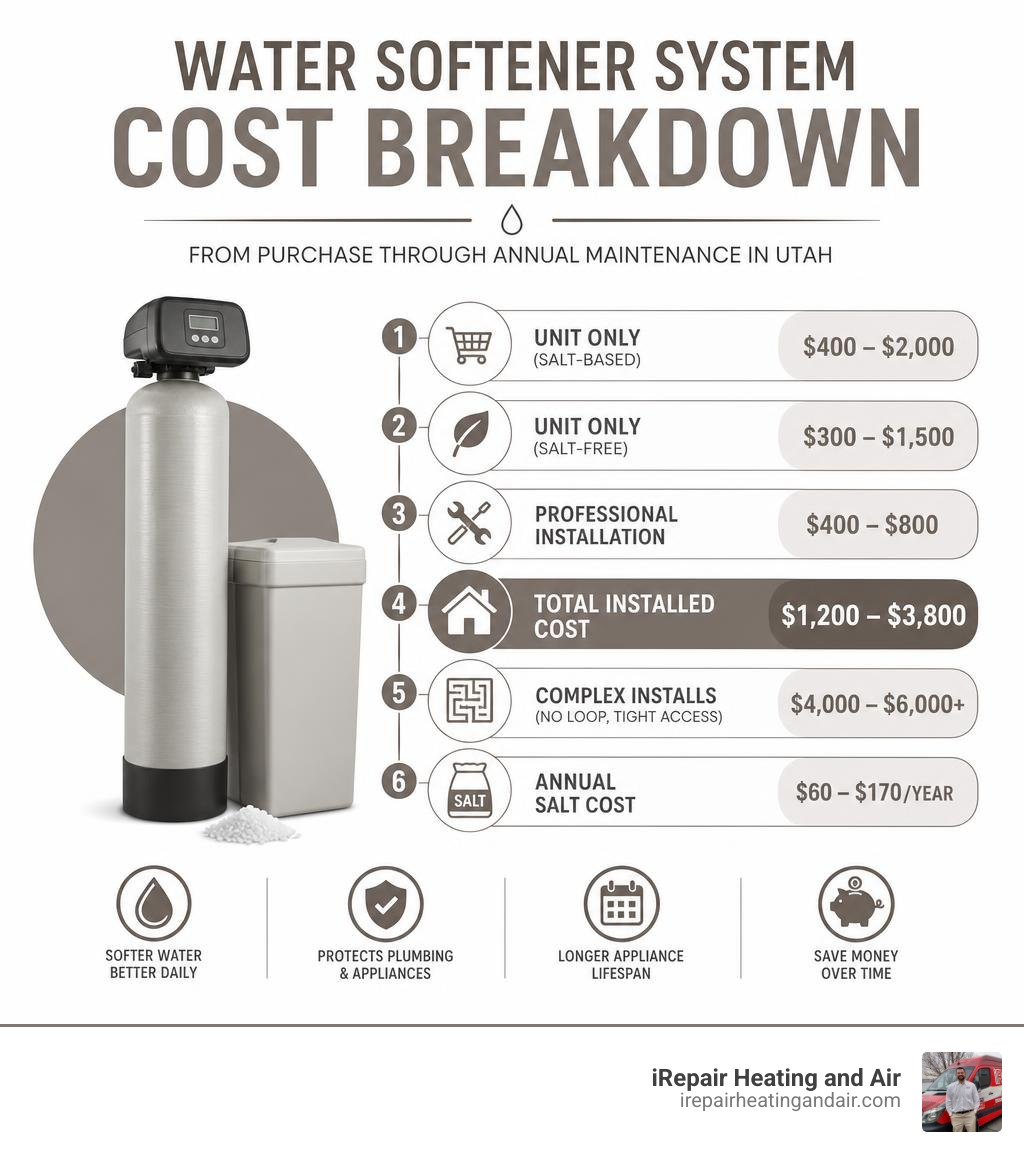
Here's what most Utah homeowners actually pay in 2026:
| Cost Type | Typical Range |
|---|---|
| Unit only (salt-based) | $400 – $2,000 |
| Unit only (salt-free) | $300 – $1,500 |
| Professional installation | $400 – $800 |
| Total installed cost | $1,200 – $3,800 |
| Complex installs (no loop, tight access) | $4,000 – $6,000+ |
| Annual salt cost | $60 – $170/year |
If your soap won't lather, your dishwasher leaves spots no matter what you do, or your water heater seems to need replacing every few years — the culprit is almost certainly hard water. Along Utah's Wasatch Front, water hardness commonly measures 15 to 28 grains per gallon (GPG). That's three to five times the national average. A quality water softener doesn't just fix those daily frustrations. It protects your plumbing, extends your appliances' lifespan by 30–50%, and can save thousands in preventable damage over the next decade.
But the price spread is wide — from a $400 box-store unit to a $6,000+ dealer-installed system. Knowing what drives that gap is how you avoid overpaying.
We are iRepair Heating & Air, a family-owned plumbing and home services company serving the Wasatch Front from Ogden to Provo. Having helped Utah homeowners navigate water softener system cost — from equipment selection to full installation — we know exactly where the money goes and where it doesn't need to.
Key water softener system cost vocabulary:
For most Salt Lake, Ogden, Provo, Park City, and Wasatch Front homes, the realistic installed price lands between $1,200 and $3,800. That includes the system, labor, standard fittings, drain setup, and basic programming.
A simple replacement in a home that already has a softener loop is usually on the lower end. A new install in an older home, crawl space, or tight mechanical room can climb fast because the plumber may need to add piping, a drain route, an air gap, or a nearby outlet.
If you want a quick outside estimate tool, this water softener cost calculator can help you compare basic ranges. Just remember: Utah’s hard water often requires larger capacity than national calculators assume.
Not every “softener” softens water the same way. That matters for both price and performance.
| System Type | Typical Unit Cost | Installed Cost Range | What It Does Best | Utah Performance |
|---|---|---|---|---|
| Salt-based ion exchange | $400–$2,000 | $1,200–$3,800 | Removes calcium and magnesium | Best for very hard water |
| Salt-free conditioner | $300–$1,500 | $900–$2,500 | Helps reduce scale adhesion | Limited in very hard water |
| Dual-tank salt-based | $1,500–$4,000+ | $2,500–$6,000+ | Continuous soft water | Good, but often more than most homes need |
| Magnetic/electronic descaler | $150–$600 | $200–$900 | Low-cost scale-control attempt | Mixed results; does not remove hardness |
| Whole-house filtration plus softener | $1,500–$5,000+ | $2,500–$7,000+ | Softening plus contaminant reduction | Useful when water test supports it |
Salt-based systems cost more to maintain because they use salt, but they actually remove hardness minerals. Salt-free systems usually cost less to operate, but they condition minerals rather than removing them. In Utah water, that difference is a big deal.
A fair installed quote should usually include:
Depending on your home, the quote may also need to include a permit, air gap, backflow protection, drain modification, pipe rerouting, or an electrical outlet. Ask before saying yes. Surprise costs are fun for birthday parties, not plumbing invoices.
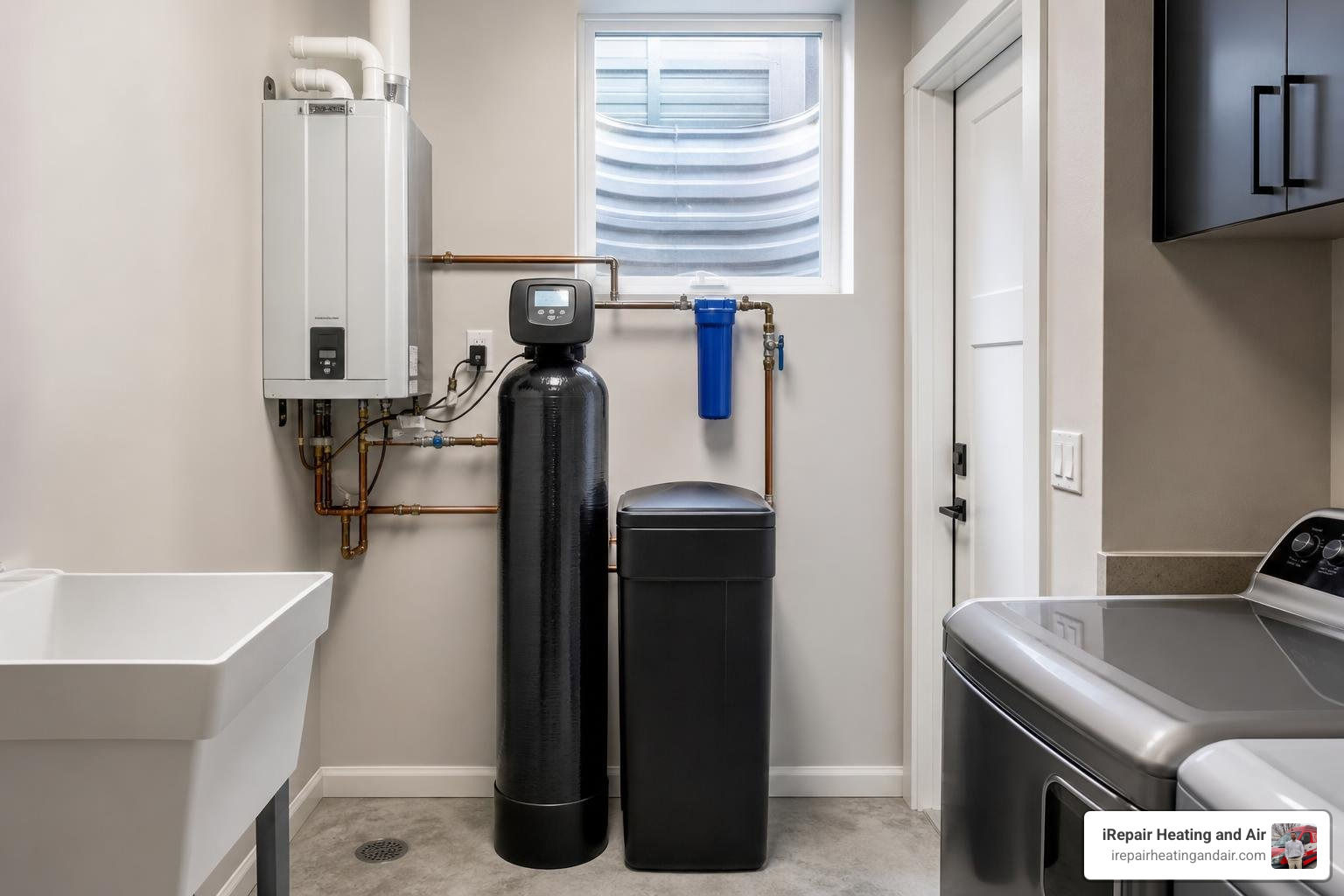
You do not always need the fanciest system on the truck. A budget-friendly water softener can make sense if:
The mistake is not buying a lower-cost system. The mistake is buying an undersized system that regenerates constantly, burns through salt, and wears itself out early.
For more ways to reduce installation costs without cutting the wrong corners, see our guide on cutting whole house water softener installation cost.
The final price depends on two big categories: the equipment and the home.
Equipment cost changes with system type, grain capacity, valve quality, tank size, resin quality, and extra features. Home cost changes with plumbing access, drain access, electrical access, and whether there is already a softener loop.
In Utah, water hardness is one of the biggest drivers. A home with 20 GPG water usually needs more capacity than a home in a softer-water region. That is why a national “average” can be misleading for Salt Lake City, Sandy, Ogden, Provo, and Park City homeowners.
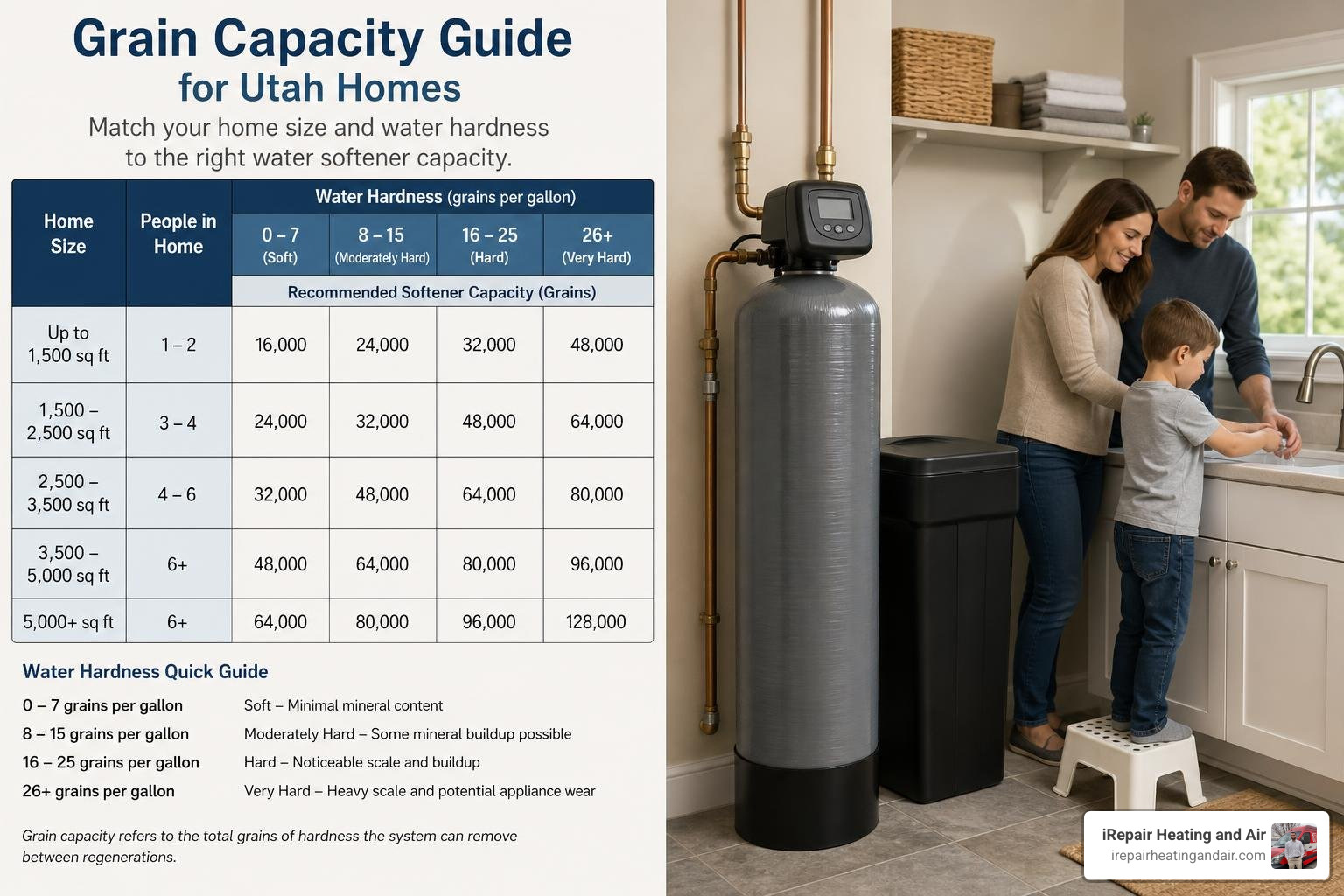
Grain capacity measures how much hardness the system can handle before it regenerates. Bigger homes and harder water need more grains.
| Grain Capacity | Typical Unit Cost | Common Fit |
|---|---|---|
| 24,000 grains | $300–$600 | Small homes, lower water use |
| 32,000 grains | $400–$1,000 | 1–3 people, moderate hardness |
| 40,000 grains | $500–$1,100 | 3–4 people, moderate to hard water |
| 48,000 grains | $600–$1,200 | Common Utah choice for 3–5 people |
| 64,000 grains | $800–$1,500 | Larger homes or very hard water |
| 80,000 grains | $1,500–$1,800+ | High usage, large homes, specialty needs |
A simple sizing formula is:
People in home x gallons per person per day x hardness in GPG = daily grain load
Most homes use about 70 to 100 gallons per person per day. For example:
4 people x 80 gallons x 20 GPG = 6,400 grains per day
A 32,000-grain unit may work, but it would regenerate often. A 48,000-grain system may be a better fit because it can run longer between cycles.
Salt-based water softeners use ion exchange. The resin inside the tank grabs calcium and magnesium, then swaps them for sodium or potassium ions. That is true softening.
Salt-free conditioners do not remove calcium or magnesium. Instead, they change how minerals behave so they are less likely to stick to surfaces. That can help with scale control, but it does not give the same shower feel, soap lather, or appliance protection as a true softener.
For Utah homes with 15 to 28 GPG hardness, salt-based systems are usually the stronger choice. Salt-free systems may still be useful in certain homes, but we do not recommend treating them as equal replacements for true softening in very hard water.
The most common hidden costs are not the tanks. They are the things needed to install the tanks correctly.
Watch for:
A clear quote should explain these before work starts. If the quote only says “install softener” with one vague number, ask for details.
A water softener installation can take 2 to 6 hours depending on the home. A simple replacement is much faster than a first-time install with new plumbing.
DIY can save money, but only when the home is ready for it. If you need to cut copper, route drains, meet code, or protect a warranty, professional installation is often the safer route.
Professional installation usually costs $400 to $800 for a standard job. Many homeowners land around $500 to $700.
Complex jobs can cost $1,000 or more when they involve:
At iRepair Heating & Air, we believe in fair, clear pricing. That means we prefer itemized, straightforward quotes over mystery math. Nobody should need a decoder ring to understand a plumbing estimate.
DIY may be reasonable if:
DIY is less attractive if the home needs new plumbing, drain changes, or code corrections. A small leak behind a wall can erase the savings quickly.
Before accepting any water softener quote, ask:
For more help comparing installers, read our guide on how to hire the best local water softener installers.
The purchase price is only part of the story. A good system should also be affordable to own.
For a broader planning perspective, this water softener cost planning guide explains how installed price, maintenance, and long-term value fit together.
Most salt-based systems cost about $75 to $200 per year to operate, depending on household size and hardness.
Common costs include:
| Item | Typical Cost |
|---|---|
| Salt | $60–$170/year |
| 40-pound salt bag | $5–$10 |
| Potassium chloride | Often $10–$30 per bag |
| Electricity | Minimal, often only a few dollars monthly |
| Regeneration water | Usually modest, varies by settings |
| Resin cleaner | Occasional low-cost maintenance |
| Professional service | As needed |
Most families check salt monthly and add a 40-pound bag every 4 to 6 weeks. In very hard Utah water, some homes use more.
Demand-initiated regeneration helps reduce waste because the system regenerates based on water use, not just a timer. That can lower salt and water use compared with older timer-based systems.
Also, do not ignore the drain setup. A poor drain connection can create messes and damage. We explain that in more detail here: water softener overflow drains.
A quality water softener usually lasts 10 to 20 years. Many standard systems last 10 to 15 years, while well-maintained higher-quality systems can reach 20 years.
Consider replacement if you notice:
A minor valve repair may be worth it on a newer system. But if the unit is old, inefficient, undersized, and failing repeatedly, replacement often makes more sense.
For most Utah homes, yes.
A softener is especially worth it when hardness is above 7 GPG and strongly worth considering above 10 GPG. Since many Wasatch Front homes test between 15 and 28 GPG, hard water is not a small nuisance here. It is a plumbing and appliance problem.
Potential benefits include:
Many homeowners see payback in 3 to 7 years, depending on water hardness, appliance age, and system cost. If you have a tankless water heater, softening matters even more because scale can collect on the heat exchanger. We cover that here: managing hard water in tankless systems.
Start with a water test. Do not guess.
Use this formula:
People x daily gallons per person x hardness GPG = daily grains to remove
Example:
4 people x 80 gallons x 20 GPG = 6,400 grains per day
Then choose a system that can go several days between regenerations. In many Utah homes, that often points toward a 40,000- to 64,000-grain system, with 48,000 grains being a common middle-ground option.
Most families check salt once a month and add a 40-pound bag every 4 to 6 weeks. Annual salt cost often falls between $60 and $170, though very hard water and high use can push that higher.
A softener can raise water use slightly because it uses water during regeneration. Efficient demand-based systems reduce that waste by regenerating only when needed.
Keep the brine tank at least partially full, but do not pack it to the ceiling. Salt bridges are real, and no, they are not the scenic kind.
Sometimes. Permit rules depend on the city, the type of work, and whether new plumbing is being added. A simple replacement may be different from a new installation.
A proper drain setup matters. Water softeners need a discharge line with correct air gap protection. Backflow protection may also be required. Common drain options include:
If you are not sure, use a licensed local professional. Our guide to local water softener installation pros explains what to look for.
The best way to avoid overpaying is to compare the total installed cost, not just the unit price.
For most Utah homeowners in 2026:
The best-value system is not always the cheapest or the most expensive. It is the one sized correctly for your water hardness, installed properly, and maintained consistently.
At iRepair Heating & Air, we help homeowners across Sandy, Salt Lake City, Ogden, Provo, Park City, and the Wasatch Front protect their plumbing from Utah’s hard water without getting soaked by inflated prices. We are family-owned, we offer same-day plumbing help when available, and we believe fair prices should come with clear answers.
Ready to price your options? Schedule local plumbing service or check our current water softener coupon.