
Call 801-233-1564
Serving Salt Lake • Ogden • Provo • Park City
Licensed Contractor
When we talk to homeowners across the Wasatch Front about tankless water heater installation utah, the first question is usually: "Is it really that much better than my old tank?" The short answer is yes, but the long answer involves understanding how these systems fundamentally change how your home consumes energy and space.
Traditional water heaters are essentially giant, insulated thermoses sitting in your basement. They spend 24 hours a day, 365 days a year, keeping 40 to 60 gallons of water hot, even when you’re sleeping or at work. This leads to "standby heat loss"—which is basically like leaving your car running in the driveway just in case you might need to drive somewhere in three hours.
In contrast, a tankless system only springs into action when you turn on a tap. Cold water travels through a high-efficiency heat exchanger (either gas or electric) and is delivered to your shower instantly.
| Feature | Traditional Tank Heater | Tankless Water Heater |
|---|---|---|
| Lifespan | 10–15 Years | 20–25 Years |
| Energy Efficiency | Standard | 24%–34% Higher |
| Hot Water Supply | Limited to tank size | Endless (On-Demand) |
| Space Required | Large (60" tall x 24" wide) | Small (28" tall x 20" wide) |
| Flood Risk | High (Tank rupture) | Minimal (No storage) |
| Monthly Cost | Higher (Standby loss) | Lower (Pay as you go) |
One of the most underrated benefits we see in Utah homes is flood prevention. We’ve all heard the horror stories of a 50-gallon tank rusting out and dumping its entire contents into a finished basement in Sandy or Salt Lake. Because a tankless unit doesn't store water, that catastrophic rupture risk is virtually eliminated. Plus, the space savings are massive. A tankless unit is about the size of a carry-on suitcase and mounts to the wall, freeing up square footage for storage or a cleaner-looking utility room. For more information on how we handle these upgrades, check out our Reliable plumbing services in Salt Lake City.
Utah is beautiful, but our environment is tough on plumbing. Two major factors dictate the success of your tankless water heater installation utah: the hardness of our water and the temperature of our ground.
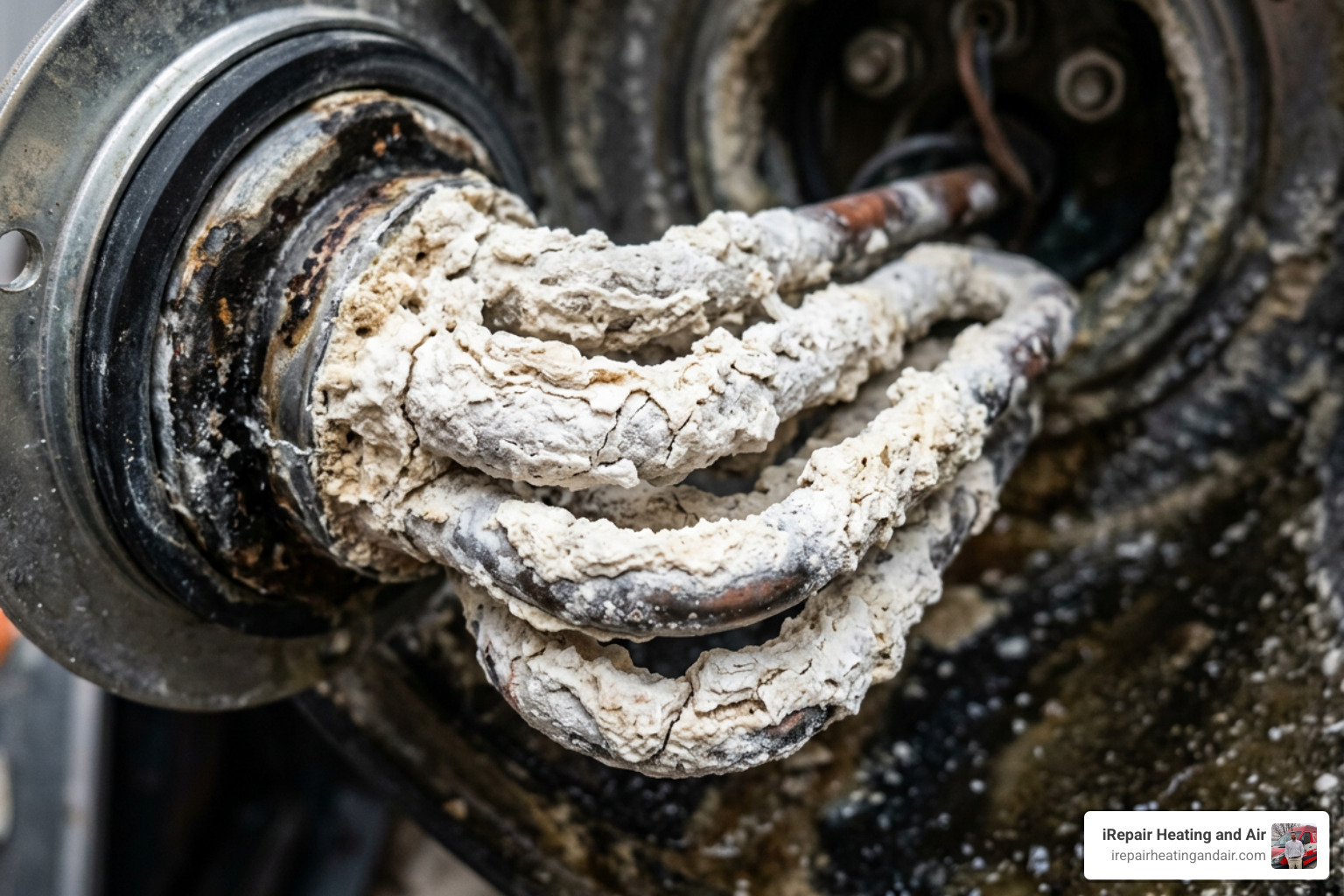
If you live in the Greater Salt Lake Area, you know about "hard water." Our water is packed with minerals like calcium and magnesium. When this water is heated quickly inside a tankless unit, those minerals solidify into limescale. Without proper protection, this scale can coat the heat exchanger, forcing the unit to work harder, reducing efficiency, and eventually causing a breakdown.
We strongly recommend pairing your new system with a water softener to protect your investment. To help with this, we offer a water-softener-coupon to ensure your whole home's plumbing stays clear of mineral deposits.
In the summer, Utah's groundwater might be a comfortable 60°F. But in the dead of winter, that incoming water can drop to a frigid 35°F. To get that water up to a comfortable 120°F shower temperature, the unit has to perform an "85-degree rise." This is where cheap, undersized units fail. A unit that provides 5 gallons per minute (GPM) in Florida might only provide 2.5 GPM during a Salt Lake City January because it takes so much more energy to heat that ice-cold water.
Sizing isn't about how much water the unit holds (since it holds none); it's about the "Flow Rate." To get your tankless water heater installation utah right, we have to calculate your "Peak Demand."
Imagine it’s 7:00 AM on a Tuesday. You are in the shower (2.5 GPM), your teenager is washing their face in the other bathroom (1.5 GPM), and the dishwasher is running (1.5 GPM). Your total peak demand is 5.5 GPM.
In Utah’s climate, we have to ensure the unit can hit that 5.5 GPM flow rate even when the incoming water is 35°F.
For a deeper dive into the technical math, the Department of Energy offers a guide on How to size a new water heater.
We love a good DIY project as much as anyone, but a tankless installation is not the place to "wing it." These systems are high-performance machines that require precise calibration.
If the upfront cost is a concern, we offer various financing options for new installations to make the transition to energy efficiency more affordable.
When planning your tankless water heater installation utah, you'll need to choose your fuel source. In our experience serving the Wasatch Front, gas is usually the winner, but electric has its place.
Gas-Powered Units: These are the "workhorses" of the tankless world. They are much better at handling the massive temperature rise needed during Utah winters. While they require more complex venting and a gas line, their operational costs are generally lower because natural gas is relatively inexpensive in Utah. They can produce higher flow rates, making them ideal for families.
Electric Tankless Units: These use high-powered heating elements. They are smaller and don't require venting, making them easier to tuck into a closet or under a sink. However, they struggle to keep up with high demand when the incoming water is very cold. We typically recommend electric models for "point-of-use" applications (like a single remote bathroom) or for very small, highly insulated condos.
If you're unsure which route is best for your specific home layout, you can Get a Quote for your installation and one of our experts will help you weigh the pros and cons.
A tankless water heater is a 20-year investment, but only if you treat it right. Because of Utah's hard water, "set it and forget it" doesn't work here.
The Annual Flush: This is the single most important thing you can do. Once a year, the unit should be flushed with a food-grade descaling solution (like white vinegar) to dissolve mineral buildup. If you skip this, the scale acts as an insulator, preventing the heat exchanger from warming the water efficiently. Eventually, the unit will overheat and shut down.
Air Filter Cleaning: Most gas units have a small air filter to keep dust and debris out of the combustion chamber. In a dusty climate like ours, these can clog every 6 to 12 months. Cleaning it takes five minutes but prevents major ignition failures.
Signs You Need a Tune-up:
To make maintenance easier, we provide a water-heaters-coupon that can be applied to your annual service visit.
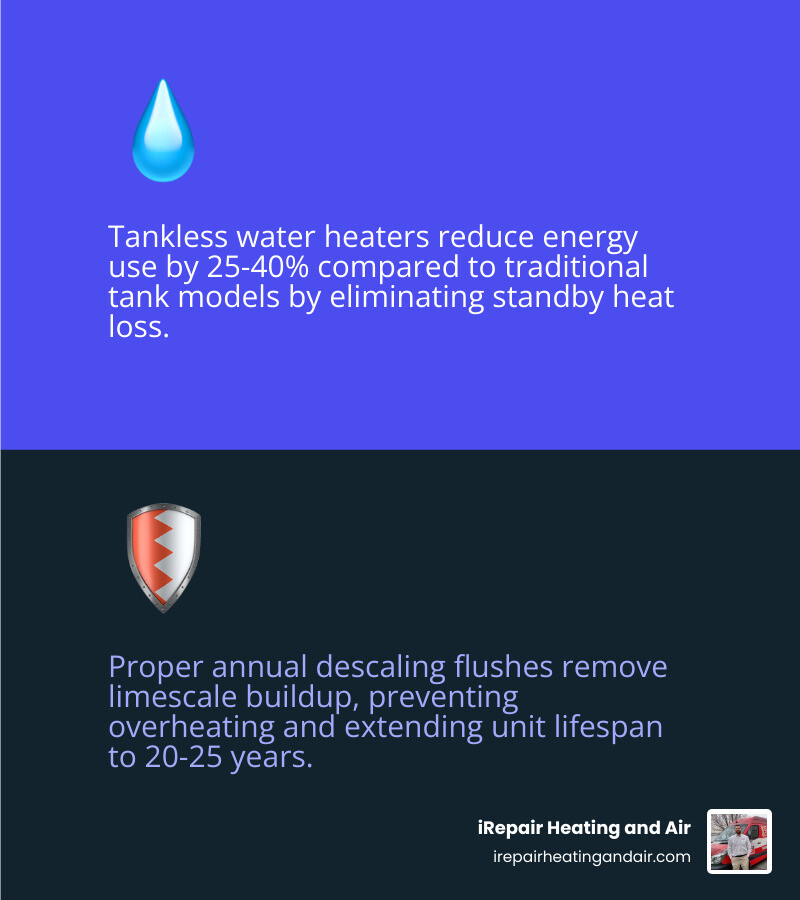
A standard tank water heater in Utah usually lasts about 10 to 12 years before corrosion takes its toll. Because tankless units don't store water, they are much more resistant to rust. With proper annual flushing, a high-quality tankless unit can easily last 20 to 25 years. You are essentially buying two traditional heaters' worth of lifespan in one unit.
Absolutely. While it’s true that the unit has to work harder in the winter, it is still significantly more efficient than a tank. A tank heater loses heat to the cold basement air 24/7. A tankless unit only uses energy when you need it. As long as the unit is sized correctly for a "cold start" (35°F incoming water), you will have endless hot water even during a blizzard.
If you notice discolored (rusty) water, a significant drop in water pressure, or if the unit is frequently cycling on and off, it's time to call us. Also, keep an eye on your utility bills. If your gas or electric bill spikes without a change in usage, your unit might be struggling against limescale buildup and losing its efficiency.
Making the switch to a tankless system is a game-changer for Utah families. No more "showering schedules," no more wasted energy, and no more bulky tanks taking up space in your basement. However, the unique challenges of our climate—from the hard water of the Salt Lake Valley to the freezing winters of Park City—mean that tankless water heater installation utah requires a professional touch.
At iRepair Heating and Air, we are a family-owned business that lives and works right here in your community. We offer same-day emergency service and fair, transparent pricing across Salt Lake City, Ogden, Provo, Park City, and Sandy. Whether you need a brand-new installation, a fast repair, or just a routine flush to keep your system running at peak performance, we’re here to help.
Ready to upgrade your home's comfort? contact-us-salt-lake-city today or learn more about our Expert Plumbing in Salt Lake City. We'll make sure you never run out of hot water again!