How to Maintain Your Water Heater Tank Without Getting Burned
Your Water Heater Won't Last Forever — Unless You Do This
Water heater tank maintenance is the routine care that keeps your unit running safely, efficiently, and for as long as possible. Here's a quick summary of what it involves:
Core water heater tank maintenance tasks:
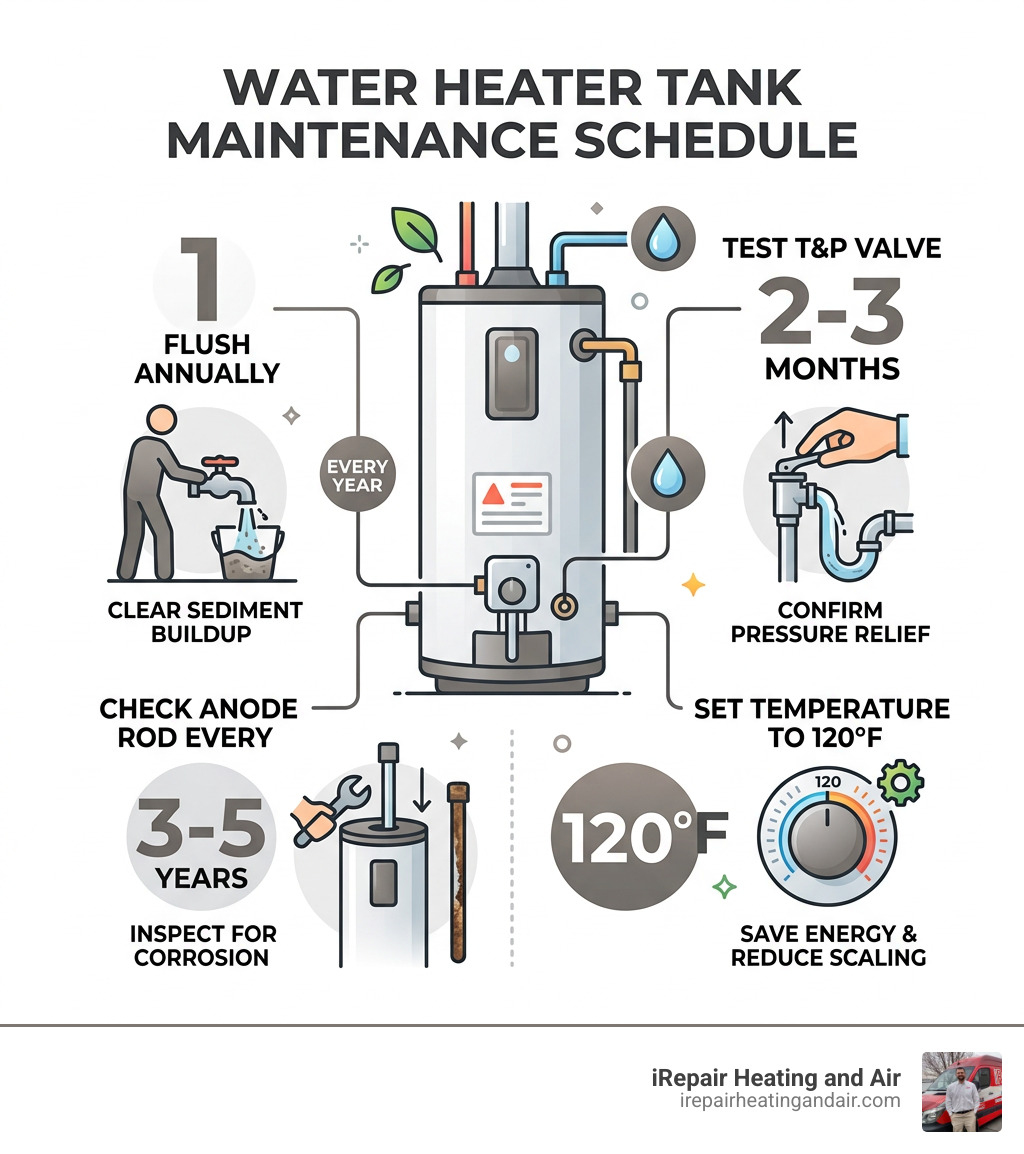
- Flush the tank — once a year (more often in hard water areas) to clear sediment buildup
- Inspect the anode rod — every 3 to 5 years; replace if worn or coated with calcium
- Test the T&P relief valve — every 2 to 3 months to confirm it opens and releases pressure
- Set the thermostat to 120°F — saves energy and reduces mineral scaling
- Insulate pipes and older tanks — cuts standby heat loss and lowers utility bills
- Visual inspection — every 2 to 3 months for leaks, corrosion, or odd smells
Most homeowners can handle these tasks themselves. But skipping them? That's how a 12-year-old water heater becomes a 7-year replacement.
Most tank water heaters last 10 to 15 years. With consistent maintenance, that number can stretch closer to 20. Without it, sediment silently builds up at the bottom of your tank, forcing your heating element to work harder, spiking your energy bill, and shortening the life of the unit — often without any obvious warning signs until something fails.
I'm Luke Jordan, owner of iRepair Heating and Air, and I've seen how a little annual attention to water heater tank maintenance can save Utah homeowners hundreds — sometimes thousands — of dollars in premature replacements. In this guide, I'll walk you through exactly what to do, step by step.
Why Water Heater Tank Maintenance Matters
If you live along the Wasatch Front, from Salt Lake City up to Ogden or down to Provo, you know we have some "character" in our water. That character is mostly calcium and magnesium—minerals that love to settle at the bottom of your water heater.
When you ignore water heater tank maintenance, these minerals create a thick layer of sediment. This layer acts like a thermal blanket between the burner (or heating element) and the water. The result? Your heater has to run longer and hotter just to give you a lukewarm shower. This extra heat stresses the steel tank, eventually leading to structural cracks and the dreaded "basement flood."
Beyond the risk of a flood, there is the "standby loss" factor. An unmaintained tank loses heat faster, forcing it to cycle on more often. By keeping the tank clean and the anode rod fresh, you ensure the unit operates at its peak efficiency. If you haven't flushed your system in a while, you can grab our water heater flush coupon to have a pro handle the dirty work for you.
The Importance of water heater tank maintenance
- Sediment Removal: Flushing out the "muck" prevents the popping and banging noises often heard in older heaters.
- Bacterial Growth: Maintaining the proper temperature prevents the growth of Legionella and other bacteria.
- Utility Bills: A clean tank can save you up to 5–9% on water-heating costs.
- System Reliability: You don’t want to find out your heater is dead on a snowy Tuesday morning in Park City. Regular checks ensure it's ready for the winter demand.
Before we dive into the tank, we need to talk about gear. You wouldn't go hiking in the Uintas without boots, and you shouldn't touch your plumbing without the right tools.
DIY water heater tank maintenance Tools
To perform a comprehensive DIY service, gather these items:
- Garden Hose: Standard length to reach a floor drain or the driveway.
- 1 1/16” Socket and Breaker Bar: Specifically for removing the anode rod.
- Teflon Tape (Plumber's Tape): To seal threads on the anode rod or valves.
- Channel Locks or Pipe Wrench: For tightening connections.
- Bucket: To catch water during the T&P valve test.
- Work Gloves and Safety Goggles: Hot water and high pressure are no joke.
- Towels: Because, let's be honest, there’s always a little splash.
Critical Safety Protocols
Safety is our number one priority at iRepair Heating and Air. Water heaters are powerful appliances that combine high-voltage electricity (or combustible gas) with scalding water and high pressure.
- Power Shutoff: For electric heaters, turn off the breaker at the main panel. For gas heaters, turn the dial to "Pilot" or "Off."
- Water Supply: Close the cold water intake valve (usually a lever or knob on the pipe entering the top of the tank).
- Scalding Prevention: The water inside is hot enough to cause third-degree burns in seconds. According to the Consumer Product Safety Commission, setting your heater to 120°F is the safest way to prevent accidents.
- Pressure Relief: Never plug a leaking T&P valve. It is the only thing keeping your water heater from becoming a rocket ship if the thermostat fails.
Step-by-Step Guide to Flushing Your Tank
Flushing is the "oil change" of water heater tank maintenance. We recommend doing this at least once a year. If you live in an area with particularly hard water, like Tooele or Sandy, twice a year isn't a bad idea.
Draining and Rinsing the System
- Cool Down: Ideally, turn off the heat the night before so the water isn't boiling. If you can't wait, be extremely careful.
- Connect the Hose: Attach your garden hose to the drain valve at the bottom of the tank. Run the other end to a floor drain or outside.
- Open a Faucet: Turn on the hot water at a sink near the heater. This breaks the vacuum and allows water to flow out of the tank easily.
- Open the Drain Valve: Use a flathead screwdriver or the handle to open the valve. Let the water flow.
- The "Cloudy" Test: Fill a bucket with the draining water. If it looks cloudy or has "sand" at the bottom, you have sediment.
- The Power Flush: While the drain is still open, flick the cold water intake valve on for 30 seconds, then off. This stirs up the sediment at the bottom so it can be washed out. Repeat until the water runs crystal clear.
- Refilling: Close the drain valve. Keep the hot water faucet in the house open. Turn on the cold water intake. When water starts coming out of the faucet without "coughing" air, the tank is full. Only then should you turn the power/gas back on.
If you find your drain valve is clogged with sediment and won't flow, don't force it. Check out our water heaters coupon and let us handle the repair.
Testing the Temperature and Pressure (T&P) Valve
The T&P valve is located near the top of the tank. It’s designed to open if the tank gets too hot or the pressure gets too high.
- The Test: Place a bucket under the discharge pipe. Gently lift the lever. You should hear a "whoosh" of water rushing into the bucket.
- The Reset: Let go of the lever. The water should stop immediately.
- The Fail: If the valve doesn't move, or if it keeps dripping after you close it, it is faulty.
| Feature |
Healthy T&P Valve |
Faulty T&P Valve |
| Handle Movement |
Moves easily and snaps back |
Stuck, frozen, or loose |
| Water Flow |
Strong, clear stream when lifted |
No flow or weak trickle |
| After Closing |
Seals completely (bone dry) |
Constant dripping or leaking |
Inspecting and Replacing the Anode Rod
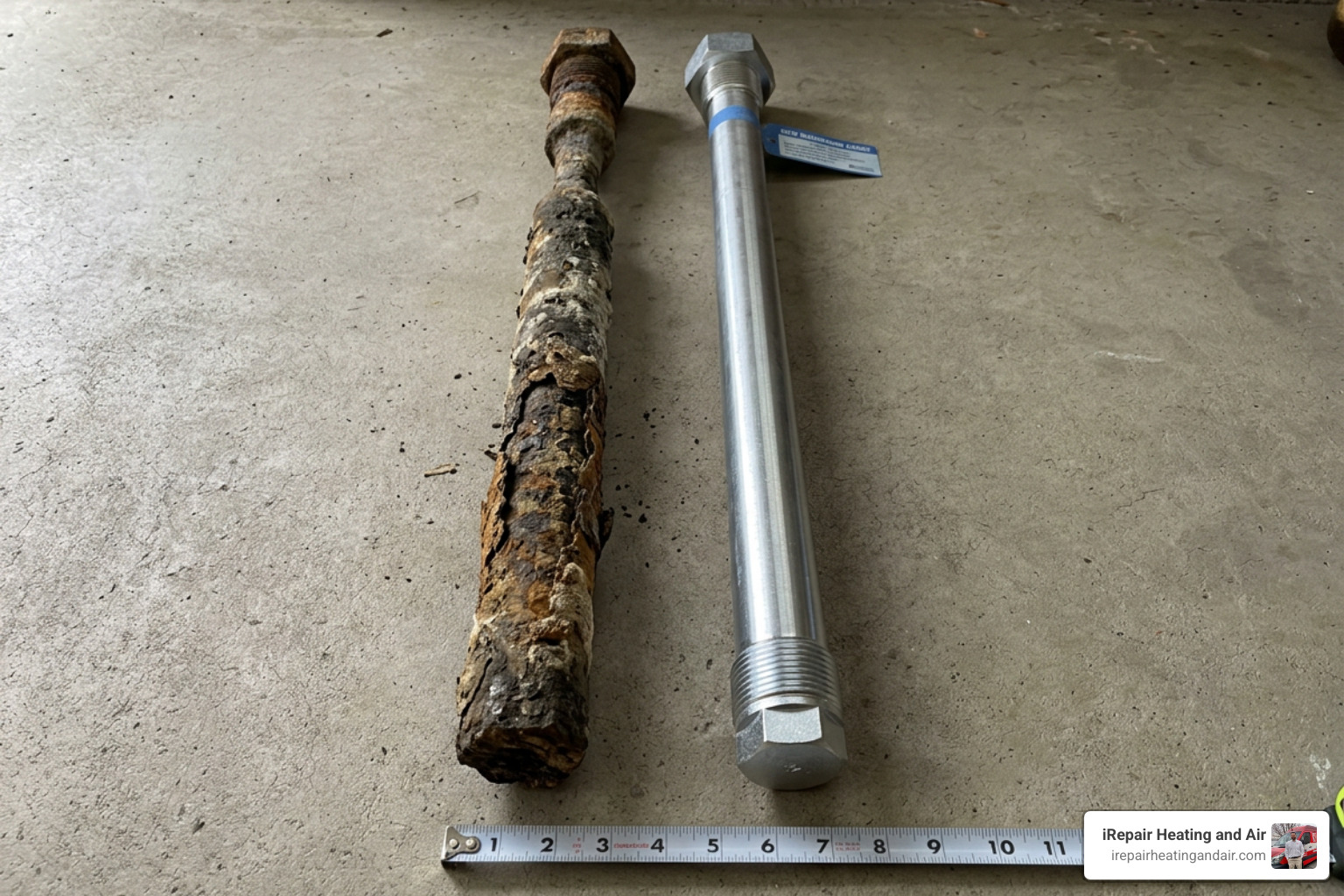
The anode rod is a "sacrificial" piece of magnesium or aluminum. Its only job is to be more attractive to corrosion than the steel of your tank. The minerals in the water eat the rod instead of the tank. Once the rod is gone, the tank is next.
We recommend checking the rod every 3 to 5 years. If you have a water softener, you should check it even more often, as softened water can actually speed up anode consumption.
When to Swap the Rod
- Turn off the water and power. Drain about 2–3 gallons of water so the level is below the top of the tank.
- Use your 1 1/16” socket to unscrew the hex head at the top of the heater.
- Pull the rod out. (Note: You may need a "flexible" rod if you have low ceiling clearance in your basement).
- Replace if:
- The rod is less than 1/2 inch thick.
- More than 6 inches of the inner steel core wire is visible.
- The rod is heavily coated in calcium "barnacles."
Wrap the threads of the new rod in Teflon tape before screwing it back in to ensure a watertight seal. For expert help in the Salt Lake City area, our team is always available to assist with rod replacements.
Maximizing Efficiency with Insulation and Temperature Settings
Once the inside of the tank is clean, it's time to focus on the outside. Most modern tanks are well-insulated, but older units can benefit greatly from a little extra "clothing."
Insulating Pipes and Tanks
- Pipe Sleeves: Use 3/8” thick foam pipe insulation on the first 6 feet of the hot and cold water pipes. This reduces heat loss and prevents "sweating" (condensation) on the cold pipe.
- Insulation Blankets: If your tank feels warm to the touch, it's losing heat. An R-4.5 foil bubble wrap or fiberglass blanket can reduce standby heat loss by 25%–45%.
- Safety Note: Never cover the top of a gas water heater, the burner access, or the T&P valve. These need air and access for safety.
- Temperature Setting: We recommend 120°F. For every 10°F you lower the temperature, you save about 3%–5% in energy costs. It also slows down the mineral buildup that causes all those maintenance headaches.
For more tips on keeping your home efficient, check out our reliable plumbing services in Salt Lake City.
When to Call a Professional for water heater tank maintenance
While DIY is great, some things require a licensed plumber. If you encounter any of the following, it’s time to call iRepair Heating and Air:
- The "Popcorn" Sound: If your heater sounds like it's making popcorn, that's steam bubbles exploding through a thick layer of sediment. If a flush doesn't fix it, the sediment may be "fossilized" at the bottom.
- Rusty Water: If only your hot water is brown or orange, the tank is likely rusting internally.
- Gas Smells: If you smell "rotten eggs" near a gas unit, leave the house immediately and call us.
- Stuck Valves: If you try to turn a valve and it feels like it's going to snap, stop. Breaking a valve can lead to an uncontrollable leak.
Signs of Tank Failure
- Age: If your tank is over 12 years old, maintenance is more about "limping it along" than prevention.
- Inconsistent Temps: If your showers are getting shorter despite maintenance, the lower heating element (in electric units) may have burned out due to sediment.
- Moisture Under the Tank: A slow drip today is a burst tank tomorrow.
If you're dealing with hard water issues that are killing your appliances, consider our water softener coupon to stop the problem at the source.
Frequently Asked Questions about Water Heater Care
How often should I flush my water heater?
In the Wasatch Front area, we recommend once a year. If you have extremely hard water and no softener, every six months will significantly extend the unit's life.
What is the ideal temperature for my water heater?
120°F (49°C) is the industry standard. It’s hot enough for sanitizing dishes but cool enough to prevent accidental scalding.
Can I perform maintenance on a gas water heater myself?
Yes, tasks like flushing and checking the T&P valve are safe for homeowners. However, if you need to clean the burner assembly or if the pilot light won't stay lit, you should call a professional to avoid gas leaks or fire hazards.
Conclusion
Taking care of your water heater isn't the most glamorous part of homeownership, but it is one of the most cost-effective. By following this water heater tank maintenance guide, you can enjoy hotter showers, lower bills, and the peace of mind that comes with a reliable system.
At iRepair Heating and Air, we are a family-owned business proud to serve our neighbors in Salt Lake City, Ogden, Provo, Park City, and Sandy. Whether you need a simple tune-up or a same-day emergency replacement, we offer fair prices and expert service across the entire Wasatch Front.
Don't wait for a cold shower to remind you about your water heater. Contact us today for more info about our plumbing services and let's keep your home running smoothly!