
Call 801-233-1564
Serving Salt Lake • Ogden • Provo • Park City
Licensed Contractor
Bryant gas furnace repair is something most Utah homeowners will face at least once — and usually at the worst possible time, like a January night when temperatures drop into the single digits.
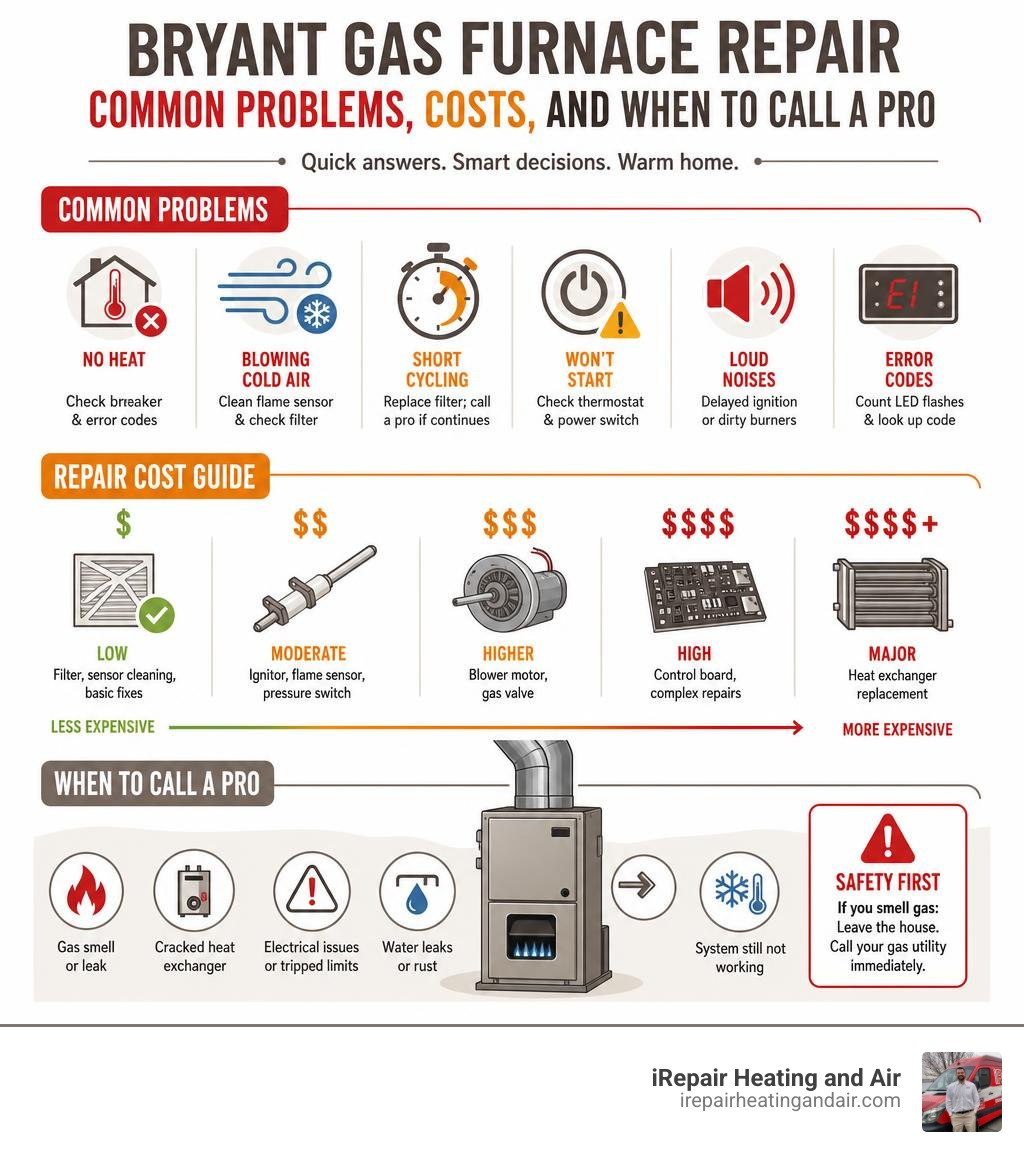
Before diving deeper, here's a quick answer to the most common repair situations:
Most common Bryant furnace problems and what to do first:
| Problem | Likely Cause | First Step |
|---|---|---|
| No heat | Tripped breaker or bad ignitor | Reset breaker; check error codes |
| Blowing cold air | Dirty flame sensor or ignition failure | Clean flame sensor; check filter |
| Short cycling | Dirty filter or faulty limit switch | Replace filter; call a pro if it continues |
| Furnace won't start | Thermostat or power issue | Check thermostat settings and SSU switch |
| Loud banging/popping | Delayed ignition or dirty burners | Call a professional |
| Error code flashing | Control board fault detected | Count LED flashes and look up the code |
If you smell gas at any point — stop, leave the house, and call your gas utility immediately. Do not attempt any troubleshooting.
Bryant furnaces are built tough. They're known across the industry for durable heat exchangers and reliable combustion systems. But even the best furnace will eventually need service — whether it's a worn ignitor, a clogged flame sensor, or a pressure switch fault triggered by Utah's cold winters.
The good news? Many Bryant furnace issues start with simple causes you can check yourself in minutes. Others need a licensed technician right away. This guide walks you through both.
At iRepair Heating and Air, we have handled Bryant gas furnace repair across the Wasatch Front for years — from straightforward ignitor swaps to complex heat exchanger inspections. We'll share exactly what our team sees in the field so you know what to check, what to watch out for, and when to call for help.
Before we touch a single tool, we need to talk about safety. Gas furnaces are complex machines that handle high-voltage electricity, natural gas, and fire. Taking the wrong shortcut can damage your system, void your manufacturer warranty, or put your family in danger.
If you plan to perform any basic diagnostics, always follow these critical safety precautions:
For a comprehensive look at how these heating systems operate under normal conditions, you can read through the Bryant Gas Furnace Troubleshooting Guide.
Many emergency service calls we receive along the Wasatch Front end up being incredibly simple fixes. Before you pay for a diagnostic fee, run through this quick checklist:
Modern Bryant furnaces feature a small circular sight glass on the lower blower door. Through this window, you can see a flashing LED light on the control board. When the furnace encounters a problem, it flashes a sequence of light signals to tell you exactly what is wrong.
The flashes represent a two-digit diagnostic code:
For example, three short flashes followed by one long flash indicates Code 31. Once you note the flash pattern, you can cross-reference it with the schematic sticker on the inside of the blower door or refer to the Bryant Gas Furnace Troubleshooting Guide.
| Error Code | What It Means | Likely Culprit | What to Do |
|---|---|---|---|
| Code 13 / 14 | Limit Circuit Lockout | Overheating or failed flame sensor | Clean filter; check for closed registers; call a pro if it persists. |
| Code 31 | Pressure Switch Did Not Close | Blocked vent, frozen condensate line, or bad inducer motor | Clear outdoor vents of snow/ice; check drain lines. |
| Code 33 | Limit Circuit Fault | Restricted airflow causing high-limit switch to open | Replace dirty air filter; open all supply registers. |
| Code 34 | Ignition Proving Failure | Burners failed to ignite or control board cannot detect flame | Clean the flame sensor; check gas supply valve. |
While Bryant furnaces are exceptionally reliable, they are subject to wear and tear. Here are the most common issues we diagnose and repair in Salt Lake City, Provo, and Ogden:
Older furnaces used a standing pilot light, but modern Bryant units rely on electronic hot-surface ignitors (HSI). These metal ignitors glow white-hot to light the gas burners. Because they cycle on and off thousands of times each winter, they naturally wear out every 5 to 8 years. A cracked or failed ignitor is responsible for roughly 35% of all "no-heat" service calls.
If your furnace fires up, runs for exactly 4 to 10 seconds, and then abruptly shuts down, you are likely dealing with a dirty flame sensor. The flame sensor is a thin metal rod that sits in the path of the flame. It sends a micro-amp electrical signal to the control board to prove that a flame is present. Over time, burning natural gas leaves a thin layer of white silica and carbon buildup on the rod. The control board loses track of the flame and shuts off the gas valve as a safety precaution. Fortunately, cleaning the rod with a piece of light emery cloth or sandpaper often resolves this issue immediately.
If you own a high-efficiency Bryant furnace (90% AFUE or higher), your system produces liquid condensation during the combustion process. This water must drain out of the furnace through plastic tubing. During freezing Utah winters, these condensate lines can freeze or become clogged with algae. When water backs up, it triggers the pressure switch, which prevents the draft inducer motor from running safely.
While changing a filter or gently cleaning a flame sensor are great DIY tasks, some issues require immediate professional intervention.
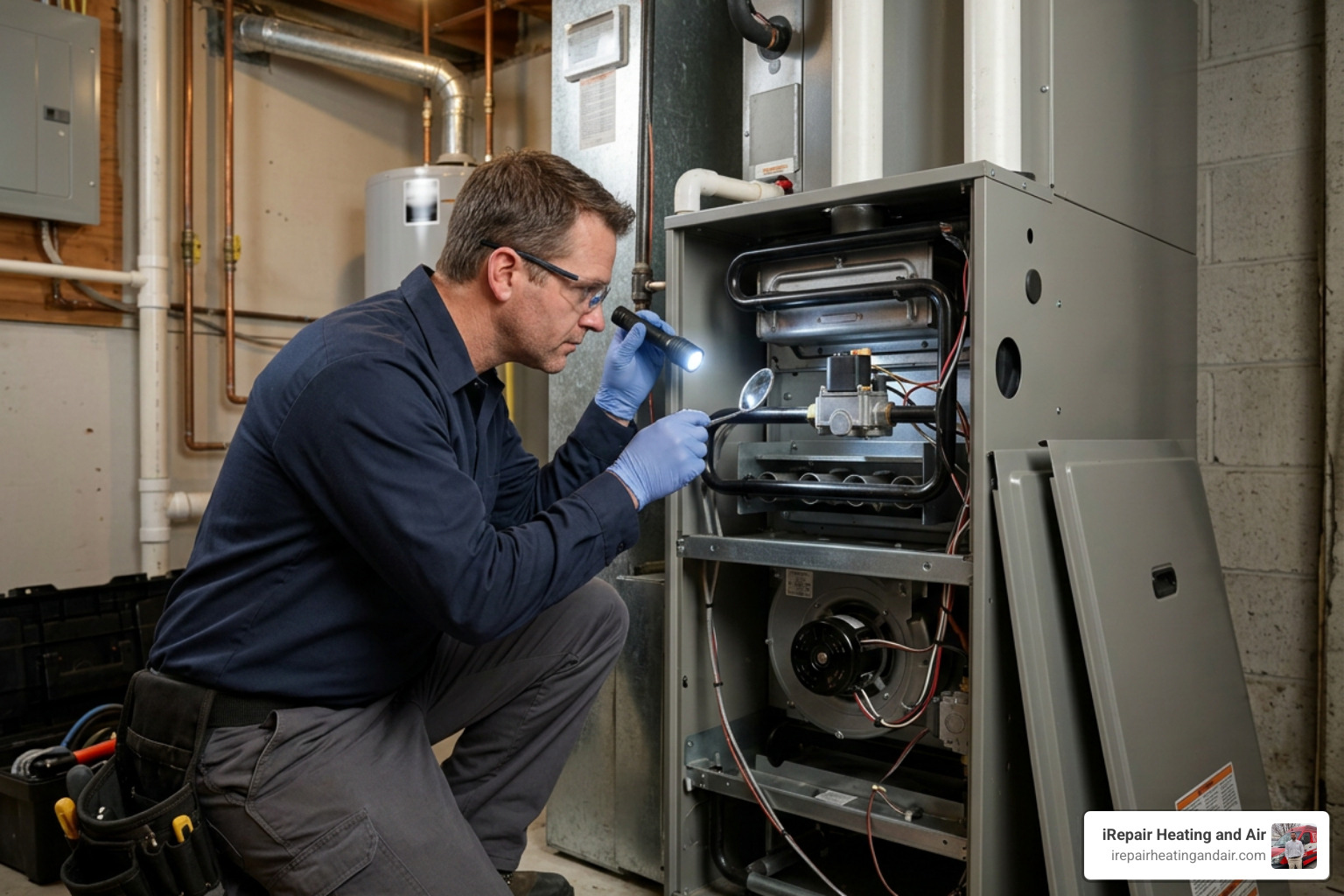
Contact our team for professional service immediately if you experience:
If you find yourself shivering in the middle of a freezing winter night, do not wait. You can reach out to us for fast relief by visiting Stay Warm All Night with Emergency Furnace Repair in SLC.
Understanding the financial side of furnace repairs helps you make smart decisions for your home. Standard HVAC diagnostic service calls generally run between $75 and $200 depending on your location and whether you require emergency after-hours dispatch.
Once the technician diagnoses the issue, standard repairs typically cost:
If your furnace was installed within the last 5 to 10 years, many of the replacement parts may still be covered under Bryant's manufacturer warranty. Bryant offers a standard 5-year parts warranty, which is upgraded to a 10-year parts warranty if the system was registered online within 90 days of installation. That these warranties cover the cost of the physical parts, but they do not cover the local technician's diagnostic fees or repair labor. To find certified warranty parts and support in your area, you can search the official directory to Find a Bryant HVAC dealer in Utah.
When you are facing a major repair bill on an older unit, you have to decide: is it better to fix it or buy a new one?
We recommend using the $5,000 Rule to guide your decision:
For example, if your 15-year-old furnace needs a new blower motor that costs $800:
Additionally, modern Bryant systems offer significantly better energy efficiency. Older units operate around 80% AFUE (Annual Fuel Utilization Efficiency), meaning 20% of your heating budget escapes up the chimney. Modern Bryant Evolution™ and Preferred™ series gas furnaces reach up to 98.3% AFUE, drastically lowering your monthly utility bills while providing quieter, more consistent heating.
This is usually caused by a safety lockout. If the furnace detects a problem — such as a dirty flame sensor, a failed ignitor, or a tripped high-limit switch due to a clogged air filter — it will shut off the gas burners for safety. However, the blower fan will continue to run to cool down the heat exchanger, which feels like cold air blowing from your vents.
With regular annual maintenance, a Bryant gas furnace typically lasts between 15 and 20 years. Neglecting regular filter changes and annual tune-ups can shorten this lifespan to 10 to 12 years due to constant mechanical strain.
To find your model and serial numbers, turn off the power to the unit, remove the front access door of the furnace cabinet, and look at the rating plate sticker on the inside upper-left metal wall. You will need these numbers if you are ordering warranty parts.
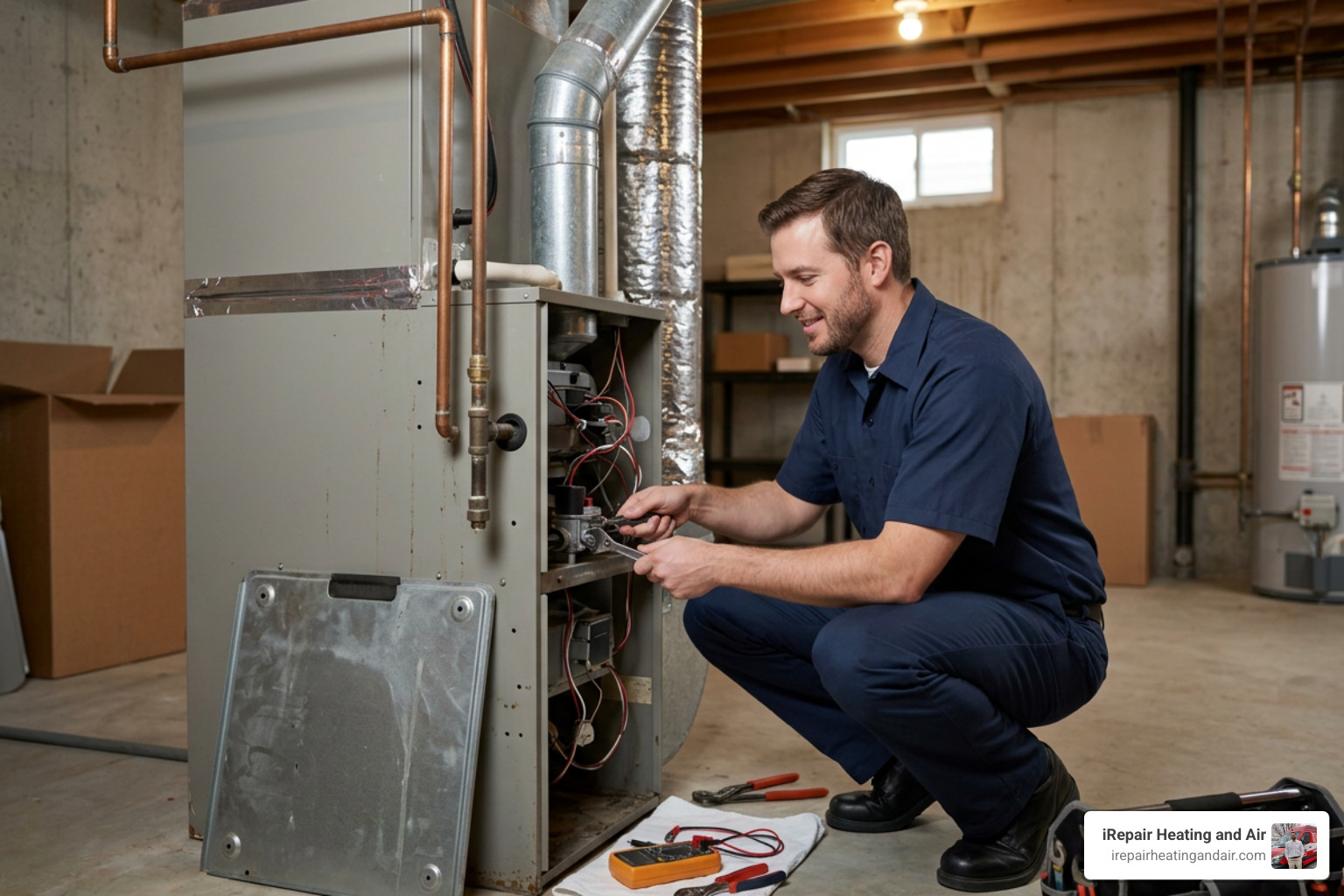
A broken furnace during a Utah winter is more than an inconvenience — it is a safety hazard for your home and family. While basic troubleshooting steps like swapping out a dirty filter or resetting a breaker can save you a service call, complex electrical and gas repairs are best left to licensed professionals.
At iRepair Heating and Air, we are proud to be a family-owned business serving Sandy, Salt Lake City, Ogden, Provo, Park City, and the entire Wasatch Front. We provide honest, fair pricing and same-day emergency services to keep your home warm and cozy no matter how cold it gets outside.
If your furnace is acting up, don't stay in the cold. Contact our local experts today by visiting Furnace Repair in Salt Lake City That Won't Leave You Shivering to schedule your diagnostic visit!