
Call 801-233-1564
Serving Salt Lake • Ogden • Provo • Park City
Licensed Contractor
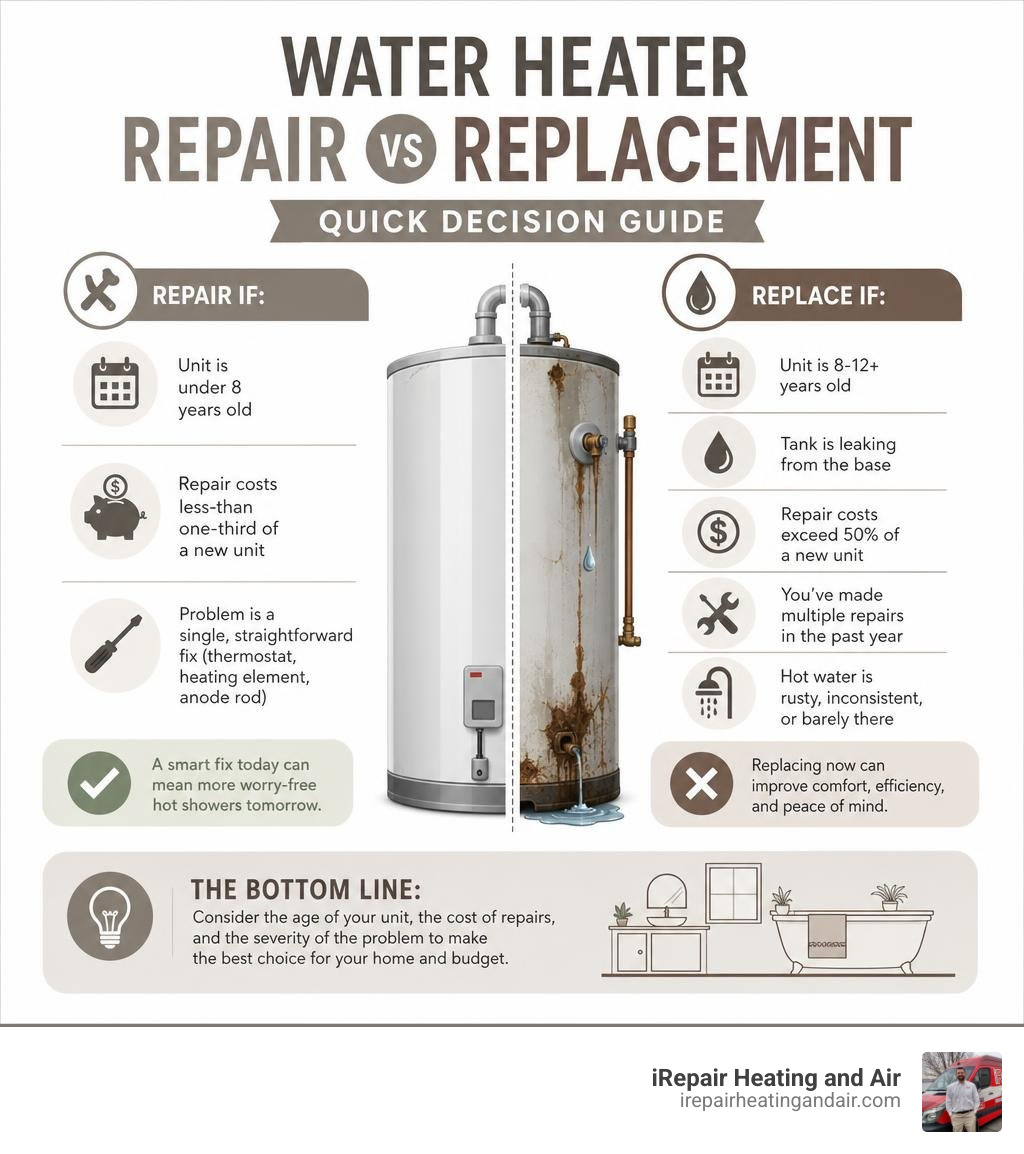
When facing a water heater repair replacement decision, here's a quick way to think about it:
Repair your water heater if:
Replace your water heater if:
A cold shower has a way of forcing a decision you've been putting off. Your water heater has been quietly working in the background for years — and now it's failing. The question isn't just "what's wrong with it?" It's "is it worth fixing, or is it time to move on?"
That's not always an easy call. The wrong choice can cost you hundreds of dollars — either on a repair that only delays the inevitable, or on a full replacement you didn't actually need yet.
At iRepair Heating & Air, we handle water heater repair replacement decisions for homeowners across Utah's Wasatch Front every day. In this guide, we'll walk you through exactly how to make the right call for your home and budget.
Water heater repair replacement terms simplified:
Water heaters usually give warning signs before they quit completely. Unfortunately, those signs often look like “minor annoyances” until you are standing in a freezing shower wondering what life choices brought you here.
Here are the most common signs your water heater needs attention.
1. No hot water
If your water heater stops producing hot water, the cause depends on the type of system:
Some of these are repairable. For example, a failed electric element may only require a hot water tank element replacement. But if the unit is old and other parts are failing too, replacement may be smarter.
2. Inconsistent water temperature
If your shower keeps switching from hot to lukewarm to “why is this happening to me,” the issue could be:
Inconsistent hot water is not always a death sentence, but it is a sign the system needs diagnosis.
3. Rust-colored hot water
Rusty water from only the hot side often points to internal tank corrosion or a worn anode rod. The anode rod is the “sacrificial” part that helps protect the tank from rust. Once it is used up, the tank itself starts taking the damage.
If the tank is younger, replacing the anode rod may buy more time. If the tank is 8-12 years old and the water is rusty, replacement is often the safer call.
4. Rumbling, popping, or banging noises
Those dramatic sounds usually come from sediment hardened at the bottom of the tank. As water heats beneath that layer, steam bubbles pop through the minerals, creating rumbling or popping noises.
This is especially common in Utah homes because hard water can speed up mineral buildup. A flush may help if the problem is caught early. If the tank is older and heavily scaled, the damage may already be done.
5. Water around the base of the tank
A leak from a valve or fitting may be repairable. A leak from the actual tank body is not.
If water is pooling under the tank and the metal shell is corroded, replacement is the answer. Tanks cannot be safely patched in a way that restores long-term reliability. A leaking tank can quickly turn into flooring, drywall, and basement damage.
6. Dripping pressure relief valve
The temperature and pressure relief valve, often called the T&P valve, is a major safety component. If it drips, leaks, or discharges water, do not ignore it. The cause could be a bad valve, excessive pressure, thermal expansion, or overheating.
This is a repair that should be handled carefully. If you are dealing with this issue, our guide to water heater pressure valve replacement explains what is involved.
7. Rising energy bills
Older tank water heaters lose efficiency over time. Sediment makes the burner or elements work harder, and aging insulation can increase standby heat loss. Modern water heaters can reduce water heating energy use, and high-efficiency systems may cut costs significantly depending on your current unit and household habits.
If your utility bills are creeping up and your water heater is nearing the end of its life, replacement may be a comfort upgrade and an efficiency upgrade.
A good water heater repair replacement decision comes down to five things:
Let’s break that down.
Age matters most.
Most traditional tank water heaters last about 8-12 years with proper care. Some electric tanks may last longer, and some gas tanks may fail sooner, especially with heavy use or hard water. Tankless water heaters often last 15-20+ years if they are descaled and maintained correctly.
If your tank unit is under 8 years old, repair is often worth considering. If it is over 10 years old, every repair needs a harder look.
Use the one-third rule for older units.
If your water heater is more than 8 years old and the repair costs more than one-third of a new installation, replacement often makes more financial sense.
Example: if a new installed water heater would cost $2,400, one-third is $800. Spending $900 on an 11-year-old tank is usually risky because another part may fail soon.
Use the 50 percent rule for major repairs.
If a repair costs 50% or more of replacement, replacement is usually the better choice. This is especially true if the system is outside warranty, has visible corrosion, or has had repeated problems.
Consider repair frequency.
One repair is normal. Two or three repairs in a year is your water heater waving a tiny white flag. Repeated thermostat failures, pilot issues, leaks, or temperature problems usually point to deeper wear.
Think about comfort, not just cost.
If your family has outgrown the water heater, repair may not solve the real problem. A 40-gallon tank that worked for two people may struggle with teenagers, guests, a soaking tub, or back-to-back showers. In that case, replacement gives you the chance to size the system properly.
For more detail on price ranges and what goes into a quote, see The Ultimate Breakdown of Water Heater Replacement Costs.
Repair is usually the right choice when the tank is still structurally sound, the unit is not too old, and the problem is limited to a replaceable part.
Common repairs that often make sense include:
A repair is especially reasonable if:
Preventive maintenance can also turn a “replace soon” situation into a “not yet” situation. Flushing sediment, checking the anode rod, and testing safety components can extend the life of a tank. If you want to do maintenance safely, start with How to Maintain Your Water Heater Tank Without Getting Burned.
Replacement is usually better when:
Water heater replacement costs vary because homes vary. A simple same-location tank swap costs less than converting from tank to tankless or moving the unit across the house.
Common cost factors include:
1. Type of water heater
Traditional tank units usually cost less upfront. Tankless and heat pump water heaters typically cost more to install but can offer better efficiency and longer service life.
2. Fuel type
Gas, electric, tankless gas, tankless electric, and hybrid heat pump units all have different equipment and installation requirements.
3. Size and capacity
A larger tank or higher-output tankless system costs more than a smaller unit. But undersizing a water heater is a classic “save now, regret every shower later” move.
4. Labor
A standard replacement in the same location is usually quicker. Extra labor may be needed for gas line changes, venting updates, electrical work, water line modifications, or relocation.
5. Permits and code upgrades
Most areas require water heater installations to meet local plumbing and mechanical codes. Depending on your home and city, this may include permit fees, expansion tank requirements, seismic strapping, proper venting, drain pans, shutoff valves, gas sediment traps, and T&P discharge piping.
6. Expansion tank
If your home has a closed plumbing system, an expansion tank may be required or strongly recommended. It absorbs pressure created as water heats and expands.
7. Disposal
Professional replacement should include safe removal and disposal of the old unit. Water heaters are awkward, heavy, and usually full of mineral sludge. Glamorous? No. Necessary? Absolutely.
8. Emergency timing
Emergency replacement can cost more than planned replacement. If your tank is old and showing warning signs, replacing it before it bursts is usually cheaper and less stressful.
If you need help evaluating your options, you can schedule professional plumbing services in Salt Lake City with our team.
For a broader national look at 2026 pricing, this overview on water heater replacement cost in 2026 is also useful for understanding general cost categories.
Choosing between tank and tankless is one of the biggest replacement decisions. Neither is automatically “best” for every home. The right choice depends on budget, hot water demand, fuel type, space, maintenance habits, and long-term plans.
| Feature | Traditional Tank Water Heater | Tankless Water Heater |
|---|---|---|
| How it works | Stores and heats a set amount of water | Heats water on demand as it flows |
| Upfront cost | Usually lower | Usually higher |
| Efficiency | Lower than most tankless systems, especially older tanks | Often much higher, especially gas condensing models |
| Hot water supply | Limited by tank size | Continuous when properly sized |
| Lifespan | Commonly 8-12 years | Often 15-20+ years with maintenance |
| Space | Takes more room | Wall-mounted and compact |
| Maintenance | Flush tank, inspect anode rod, test valves | Descale, clean filters, inspect venting |
| Best for | Lower upfront cost, simple replacement | High demand, space savings, long-term efficiency |
| Drawback | Can run out of hot water | Higher install cost and sensitive to scale |
Tank water heaters are familiar, reliable, and cost-effective. If your current tank has served your home well and the installation location is code-compliant, a like-for-like replacement may be the easiest path.
Tankless water heaters are great for homeowners who want continuous hot water and better efficiency. They are especially appealing for larger households or homes where space is limited. However, tankless systems need proper sizing, correct gas or electrical capacity, good venting, and regular maintenance.
If your tankless system is acting up, see Cold Shower Blues: How to Fix Your Tankless Heater Fast. If you are considering switching, we also explain local options here: Local Experts for Tankless Service and Replacement in Utah.
What brands are reliable?
We focus less on hype and more on proper sizing, warranty support, parts availability, efficiency ratings, and installation quality. Well-known manufacturers such as Bradford White, Rheem, A.O. Smith, Navien, and Rinnai all make strong options in the right application.
The most reliable water heater is not just the one with the best sticker on the box. It is the one that is:
Utah water is often mineral-rich, especially along the Wasatch Front. That means calcium and magnesium can build up inside water heaters over time. Hard water is not usually dangerous to drink, but it can be rough on plumbing equipment.
In tank water heaters, hard water can cause:
In tankless systems, hard water can cause:
Essential maintenance includes:
Annual tank flushing
Flushing removes sediment before it hardens into a thick mineral layer. In hard water areas, annual flushing is one of the best ways to extend tank life. If it has been many years since the last flush, call a professional first; old drain valves can break or clog.
You can save on this service with our Water Heater Flush Coupon.
Anode rod inspection
The anode rod protects the tank from corrosion. It should typically be inspected every few years and replaced when depleted. In hard water conditions, it may wear faster.
Tankless descaling
Tankless units should be descaled regularly, often annually in hard water areas. This flushes mineral buildup out of the heat exchanger. Learn more in Tankless Water Heater Maintenance Tips for Endless Hot Showers.
Water softening or scale control
A water softener or scale-control system can reduce mineral damage, especially for tankless water heaters. Our guide to managing hard water in tankless systems explains why this matters.
Temperature setting check
Most homes do well around 120 degrees Fahrenheit. Higher temperatures increase scald risk and can accelerate mineral scaling.
Visual inspections
Once a month, glance at the water heater. Look for moisture, rust, corrosion, scorch marks, loose venting, or unusual sounds. This 30-second check can prevent a very expensive surprise.
Water heaters are simple in theory: cold water goes in, hot water comes out. But when something goes wrong, the details matter. Here are the questions we hear most often from Utah homeowners.
Most traditional tank water heaters last about 8-12 years with proper maintenance. Some electric tanks can last 10-15 years, while gas tanks commonly land in the 8-12 year range. Water quality, usage, installation quality, maintenance, and location all affect lifespan.
Tankless water heaters often last 15-20+ years when maintained correctly. That “when maintained correctly” part is important. Hard water scale can shorten tankless life if the system is not descaled.
A good replacement timeline looks like this:
If your tank is past the 8-12 year range, proactive replacement can help you avoid emergency service, water damage, and the joyless adventure of mopping at 2 a.m.
In many Utah cities and jurisdictions, water heater replacement may require a plumbing or mechanical permit, especially when fuel, venting, electrical, gas, or plumbing connections are involved. Requirements can vary by city, county, and installation type.
Permits and code requirements exist for safety. Water heaters involve pressure, high temperatures, electricity or gas, combustion venting, and water damage risk. A poor installation can create serious hazards.
Common code-related items may include:
A licensed professional should know what your local jurisdiction requires and make sure the installation passes inspection when required.
If your water heater is leaking, making dangerous noises, producing scalding water, or you smell gas, take immediate safety steps before calling for help.
If the tank is leaking:
If you smell gas:
If there is no hot water:
Check simple items first:
Do not remove panels, touch wiring, open gas components, or bypass safety devices unless you are trained. Water heaters are not a great place for “let’s see what this does” energy.
The water heater repair replacement debate does not have to be stressful. Start with the age of the unit, identify the failure, compare repair cost against replacement cost, and factor in efficiency, safety, and your household’s hot water demand.
Here is the simple version:
At iRepair Heating & Air, we help homeowners in Sandy, Salt Lake City, Ogden, Provo, Park City, and across the Wasatch Front make practical, budget-conscious decisions. We are family-owned, we offer same-day emergency service, and we believe in fair prices without scare tactics.
Need help now? Start here:
Hot water should be boring, reliable, and always there when you need it. If yours is becoming dramatic, we are ready to help.

