

Call 801-233-1564
Serving Salt Lake • Ogden • Provo • Park City
Licensed Contractor

Whole house water softener system installation is one of the most effective ways to protect your home's plumbing, appliances, and water quality — all at once.
Here's a quick overview of how it's done:
Hard water is a real problem in Utah and across the country. In fact, 85% of U.S. homes deal with hard water, and water above 7 grains per gallon (GPG) can shorten appliance lifespan by up to 30%. Scale buildup clogs pipes, wears out water heaters, and leaves your skin feeling dry and itchy.
The good news? A whole-house water softener solves all of that — if it's installed correctly.
At iRepair Heating & Air, we've seen how hard Utah water can quietly destroy plumbing and appliances across the Wasatch Front, and how the right water softener installation can reverse that damage fast. As a family-owned team serving Salt Lake City, Ogden, Provo, and Park City, we've helped hundreds of Utah homeowners navigate the full whole house water softener system installation process — from sizing the unit to the final leak check.
This guide walks you through everything you need to know, whether you're planning a DIY install or deciding when to call a pro.
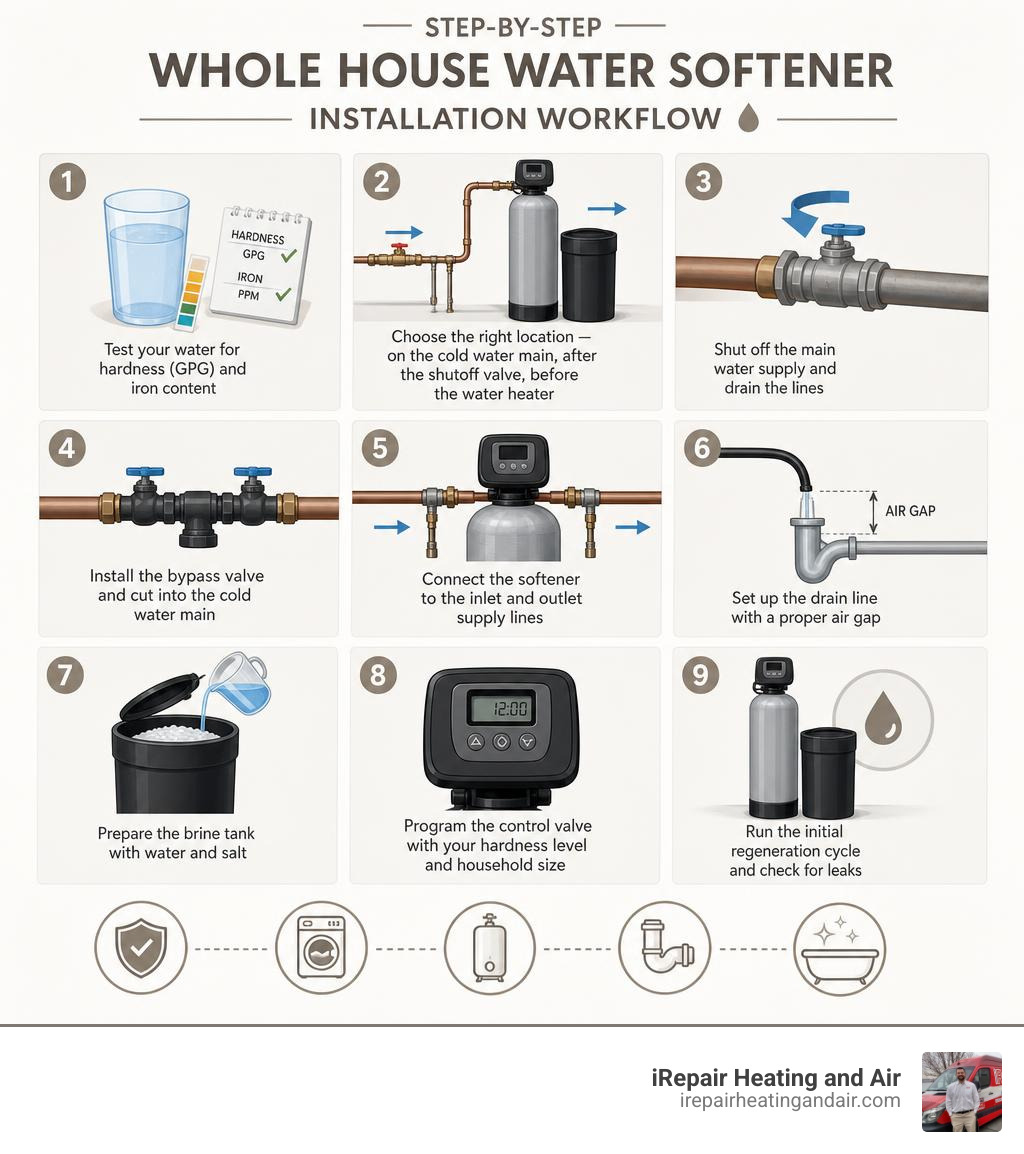
Whole house water softener system installation terms to know:
To understand why a water softener is so crucial, you first have to understand the chemistry of hard water. Hard water is simply water that contains high concentrations of dissolved minerals, primarily calcium and magnesium.
These minerals are measured in GPG (Grains per Gallon) or PPM (Parts per Million). When hard water is heated or left to dry, these minerals crystallize and form a rock-hard layer of crust known as scale. Scale behaves like a silent plumbing killer. It narrows the inside of your pipes, restricting water flow and forcing your water heater to work twice as hard to heat water through a thick mineral barrier.
This is especially devastating for high-efficiency tankless water heaters, where even a thin layer of scale on the heat exchanger can cause the system to overheat and fail prematurely. To understand how hard water impacts these modern systems, read our guide on Softening the Blow: Managing Hard Water in Tankless Systems.
Beyond your pipes, hard water reacts poorly with soaps and detergents, leaving a sticky curd (soap scum) instead of a rich lather. This soap scum clings to your shower walls, your dishes, and even your skin and hair, stripping away natural oils and leaving you feeling itchy and dry.
If you aren't sure whether you need a system, your home is likely already giving you clues. Look out for these telltale signs of hard water:
Traditional water softeners use a chemical process called ion exchange to eliminate hard water minerals.
Inside the main mineral tank are thousands of tiny plastic resin beads. These beads hold a negative electrical charge and are pre-loaded with positively charged sodium or potassium ions. Because calcium and magnesium have a much stronger positive charge than sodium, they act like magnets when hard water enters the tank. The hard minerals stick to the resin beads, displacing the sodium ions into the water supply.
Eventually, the resin beads become completely coated in calcium and magnesium and can no longer soften water. When this happens, the system goes through a regeneration cycle. During regeneration, a highly concentrated salt brine solution from the brine tank is flushed through the resin tank. This massive dose of sodium forces the calcium and magnesium off the beads and sends them down the drain in a backwash cycle, resetting the system for another round of softening.
Modern systems use metered controls that track your actual water usage to regenerate only when necessary, which is far more efficient than older timer-based systems. For a visual overview of how these units function within your plumbing, check out How To Install a Whole-House Water Softener - This Old House.
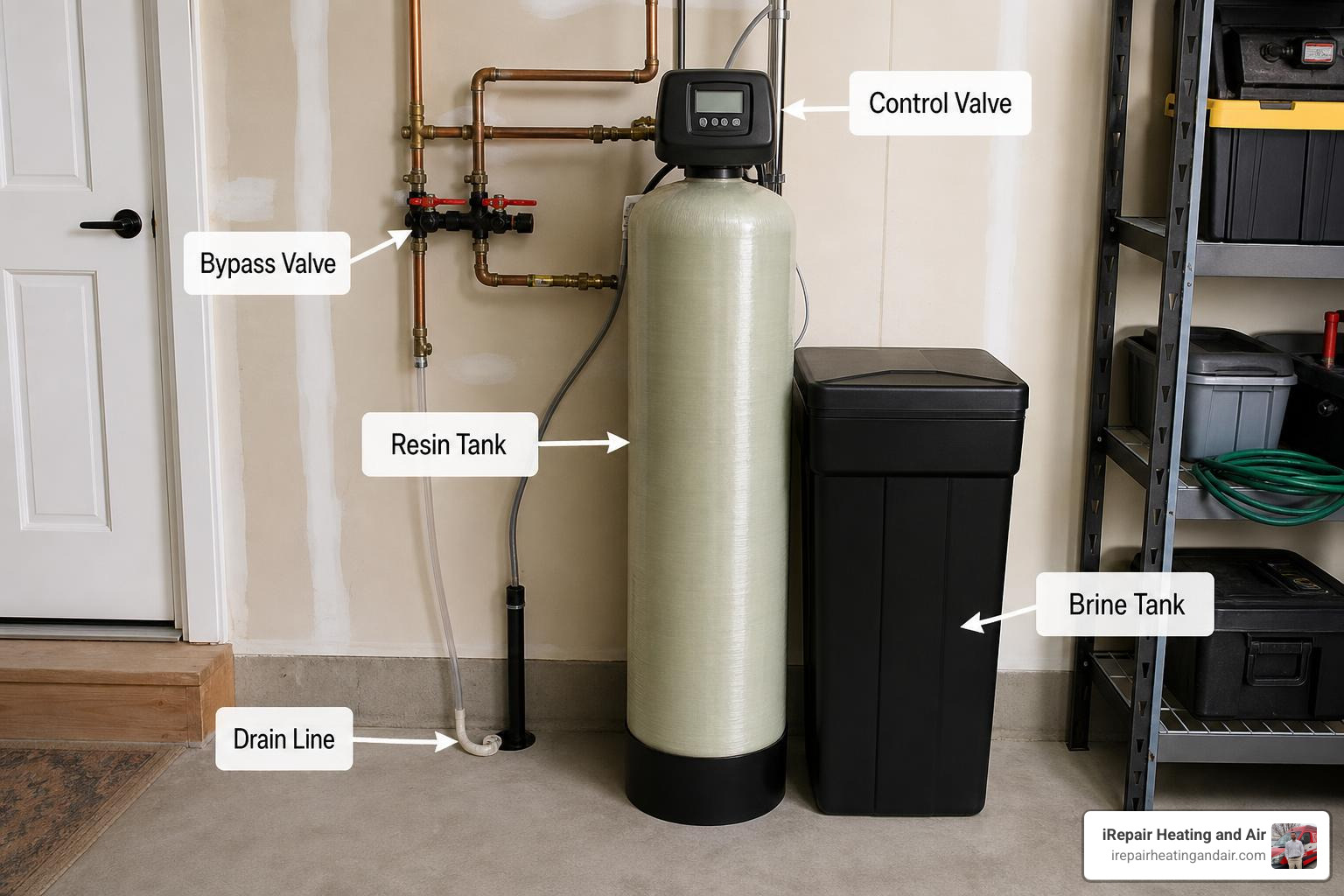
A complete whole-house water softener setup consists of several key working parts:
Before jumping into your installation, weigh the pros and cons of adding a water softener to your home:
Benefits:
Drawbacks:
A successful whole house water softener system installation requires careful planning. Do not buy a system and start cutting pipes without analyzing your home's water quality, plumbing layout, and space requirements.
First, perform a thorough water test. You need to know your water's exact hardness in grains per gallon (GPG). If you are on well water in areas like Park City or outer Ogden, you should also test for iron and manganese. Ferrous iron (clear-water iron) will quickly ruin standard resin beads if you do not account for it during sizing. If your water contains iron, you will need to add 4 GPG to your hardness calculation for every 1 PPM of iron detected.
The ideal installation location must meet several strict plumbing and structural requirements:
Verify that your home's water pressure does not exceed 125 PSI. If your pressure is too high, you must install a pressure-reducing valve (PRV) before the water softener.
Identify your main pipe material (copper, PEX, or CPVC) so you can buy the correct fittings. Make sure you read the manufacturer's installation manual thoroughly to protect your warranty. Many manufacturers require the system to be certified to NSF/ANSI Standard 44 to maintain full coverage.
| Tool / Material | Purpose | Required for DIY? |
|---|---|---|
| Pipe Cutter | Cleanly cuts copper, PEX, or CPVC pipes | Yes |
| Adjustable Wrenches | Tightening compression fittings and bypass connections | Yes |
| Plumber's Tape (Teflon) | Sealing threaded pipe connections to prevent leaks | Yes |
| Flexible Supply Tubes | Connects plumbing lines to bypass valve with ease | Highly Recommended |
| Air-Gap Fitting | Prevents sewer backup into the drain line | Yes (Code Requirement) |
| Salt Pellets | High-purity evaporated salt for brine tank setup | Yes |
Sizing a water softener isn't about physical dimensions; it's about grain capacity. To calculate your required size, use this simple formula:
$$\text{Daily Softening Demand} = \text{People in Household} \times 80 \text{ Gallons/Day} \times \text{Water Hardness (GPG)}$$
For example, a family of 4 living in Salt Lake City with a water hardness of 10 GPG would require:
$$4 \times 80 \times 10 = 3,200 \text{ Grains of Hardness Removed Daily}$$
To prevent the system from regenerating too frequently (which wastes salt and water), size the unit to regenerate once every 7 days. In this case, $3,200 \times 7 = 22,400$ grains. A standard 30,000-grain system would be perfect. We always recommend choosing one size larger than your minimum calculation to extend the life of your resin and handle heavy water-use days.
Once you have gathered your tools, planned your location, and purchased the correctly sized unit, you are ready to begin the installation. For additional insights on residential setup procedures, refer to How to Install a Water Softener in Your Home.
Locate your home's main water shutoff valve (usually near your water meter or where the main water line enters your home). Turn the valve completely off.
Next, open the highest and lowest faucets in your home to drain the remaining water out of your pipes. This relieves system pressure and prevents water from flooding your workspace when you cut into the main line. Keep a clean bucket handy to catch any residual water that drips out of the cut pipes.
Using a pipe cutter, carefully cut out a section of your main cold water line. Ensure your cuts are straight and clean. Debur the edges of the cut pipe to remove any sharp copper or plastic shavings.
Install your bypass valve onto the water softener's control head. Pay close attention to the flow direction arrows stamped on the valve body. The "Inlet" must connect to the water supply coming from your water meter, and the "Outlet" must connect to the pipe leading into your home.
If you are using PEX pipe, push-to-connect fittings make this step incredibly simple. If you are working with copper, you must solder your adapter fittings before connecting them to the plastic bypass valve to avoid melting the plastic.
Use flexible, braided stainless steel supply tubes to connect your home's plumbing to the bypass valve. Flexible tubes are highly superior to hard-piping because they absorb minor system movements, simplify alignment, and make it incredibly easy to disconnect the unit for servicing later.
Apply plumber's Teflon tape to all threaded connections. Hand-tighten the fittings, then give them an additional quarter-turn with an adjustable wrench. Avoid over-tightening plastic fittings, as they can easily crack and cause catastrophic leaks.
Your water softener needs two separate drain lines: the valve backwash drain line and the brine tank overflow line.
Run a 1/2-inch inner diameter drain hose from the valve drain port to your floor drain or standpipe. Ensure the line slopes downward with no kinks. To comply with local plumbing codes and prevent sewer water from backing up into your drinking supply, you must maintain a physical 1.5-inch air gap between the end of the drain line and the top of the drain opening.
For complete instructions on routing these lines safely, check out Everything You Need to Know About Water Softener Overflow Drains.
Connect the small plastic brine line between the mineral tank and the brine tank's safety float assembly. Ensure the connection is tight and secure.
Pour 3 to 4 gallons of clean water directly into the bottom of the brine tank (unless your specific manufacturer's manual states otherwise). Next, load the brine tank with at least 40 to 80 pounds of high-purity water softener salt or potassium chloride pellets. Keep the salt level at least one-quarter full at all times.
Plug the water softener's power cord into a grounded 120V outlet. The digital screen on the control head will light up.
Program the current time, your tested water hardness level (in GPG), your household size, and your desired regeneration time (usually set to 2:00 AM when water usage is minimal). The system's internal meter will use this data to calculate exactly how many gallons of water it can soften before it must regenerate.
With the bypass valve still in the "Bypass" position, slowly turn your main water supply valve back on. Check your cut-in connections for any leaks.
Next, slowly open the inlet valve on the bypass to allow water to fill the resin tank. You will hear air purging through the drain line. Once the resin tank is pressurized, manually initiate a regeneration cycle on the control head.
This initial cycle will run for 80 to 120 minutes, thoroughly flushing out any manufacturing residue, packing dust, and air from the system. Once the cycle finishes, test a water sample from a nearby faucet to verify your hardness is now below 1 GPG.
Before deciding to tackle this project yourself, it is important to understand the balance of cost, effort, and risk involved.
Installing a water softener yourself is highly rewarding and can save you several hundred dollars in labor fees. However, it requires a moderate level of plumbing comfort. If you have never cut into a main water line, soldered copper pipe, or routed code-compliant drain lines, a mistake can lead to major water damage or code violations.
Hiring a professional plumber guarantees that your system is sized correctly, installed to meet local Utah plumbing codes, and backed by a labor warranty. If you are unsure which path to take, read our guide on How to Hire the Best Local Water Softener Installers.
The cost of whole house water softener system installation in May 2026 depends heavily on the system type and whether you hire a professional:
To keep your water softener running efficiently for decades, follow this simple maintenance routine:
Avoid these frequent pitfalls during your installation:
With high-quality salt and regular maintenance, a professional-grade whole-house water softener will easily last 15 to 25 years. The main control valve and brine tank are highly durable, but the resin beads themselves will typically need replacement after 10 to 15 years due to chlorine exposure from municipal water.
No. Standard carbon filters or sediment filters are designed to remove chemicals, taste, odor, and physical particles. They cannot remove dissolved minerals like calcium and magnesium. Only an ion-exchange water softener or a specialized water conditioner can resolve hard water scale.
Yes, softened water is perfectly safe for the vast majority of people. The amount of sodium added during ion exchange is incredibly small. However, if you are on a medically restricted low-sodium diet, you can use potassium chloride pellets in your brine tank instead of traditional salt, or install a dedicated reverse osmosis drinking water system at your kitchen sink.
We recommend testing your water hardness before purchasing a system, immediately after startup to verify performance, and then once a year to ensure your control valve is operating efficiently. Well water users should test more frequently, as mineral levels can shift seasonally.
A whole house water softener system installation is one of the smartest investments you can make for your home. By removing hard minerals at your main water line, you protect your plumbing, double the lifespan of your water heater, and enjoy cleaner dishes and softer skin.
While a DIY installation is entirely possible for handy homeowners, it requires precision, patience, and a solid understanding of plumbing codes. If you prefer the peace of mind that comes with professional, code-compliant installation, we are here to help. At iRepair Heating & Air, we offer same-day emergency plumbing service, upfront pricing, and expert water treatment solutions throughout Sandy, Salt Lake City, Ogden, Provo, and Park City.
Ready to say goodbye to hard water for good? Schedule plumbing help for your water softener installation with our family-owned team today, and don't forget to grab our Water Softener Coupon to save on your upcoming upgrade!
