
Call 801-233-1564
Serving Salt Lake • Ogden • Provo • Park City
Licensed Contractor
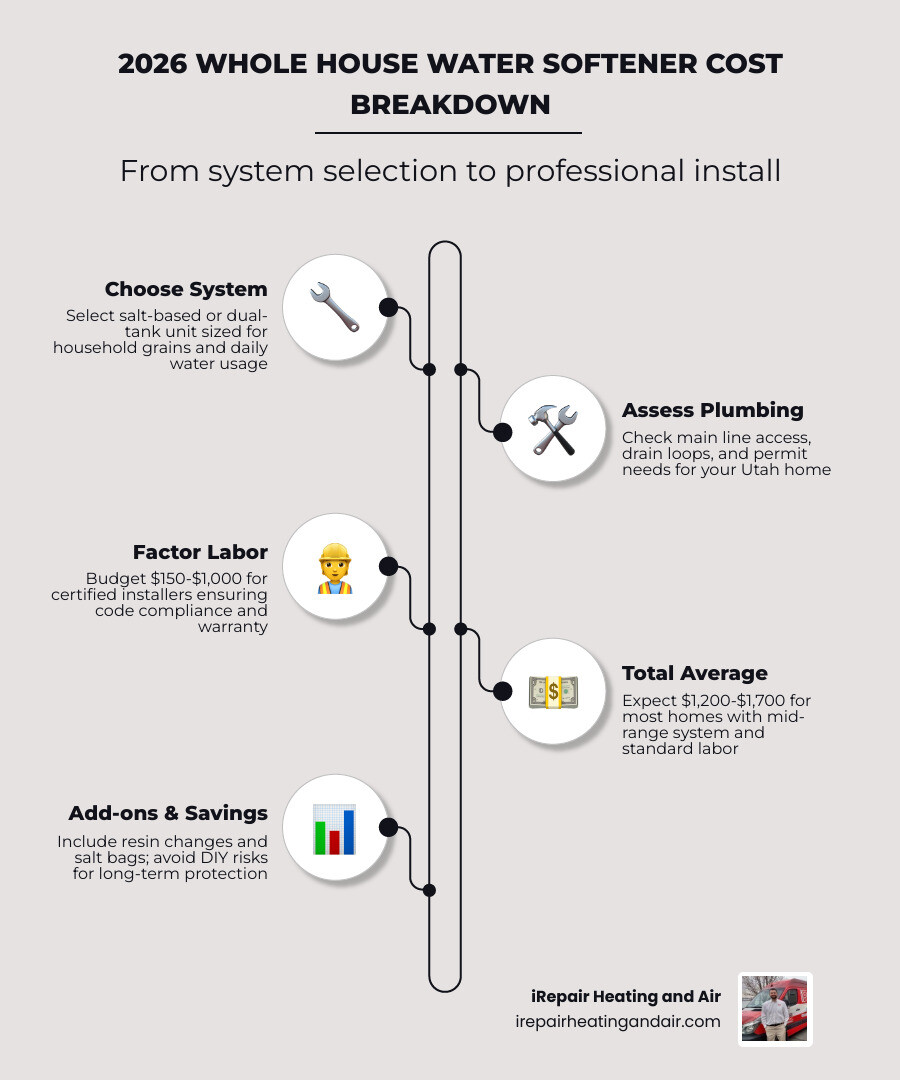
Whole house water softener installation cost typically falls between $1,000 and $3,000 for most Utah and US homes — covering both the system and professional labor. Here's a quick breakdown:
| Cost Level | Price Range | What's Included |
|---|---|---|
| Low end | $800 – $1,200 | Basic salt-based system, simple install |
| Average | $1,200 – $1,700 | Mid-range system, standard labor |
| High end | $2,500 – $4,500 | Dual-tank, complex plumbing, permits |
| Premium | Up to $11,000 | Whole-home reverse osmosis systems |
The national average in May 2026 is around $1,500, with most homeowners landing between $1,200 and $1,700 for a professionally installed salt-based system.
Hard water is a real problem — especially along Utah's Wasatch Front, where mineral levels can be among the highest in the country. Scale builds up inside pipes, on fixtures, and inside appliances like water heaters and dishwashers, quietly shortening their lifespan and driving up your utility bills. A whole house water softener solves this at the source. But before you commit, it helps to know exactly what you're paying for — and where you can cut costs without cutting corners.
At iRepair Heating and Air, we've helped hundreds of homeowners across Salt Lake City, Ogden, Provo, and Park City navigate whole house water softener installation costs — from choosing the right system size to avoiding expensive plumbing surprises. Our team understands Utah's unique water conditions and what it actually takes to get a system installed correctly the first time.
Whole house water softener installation cost terms to learn:
For most homes we see in Utah, the total installed price usually lands in the same broad range reported nationally: about $800 to $4,000 for standard projects, with $1,500 sitting near the middle. Simpler installs on existing plumbing loops cost less. Larger homes, tougher water, or more complicated mechanical rooms cost more.
A useful way to think about whole house water softener installation cost is to split it into two buckets:
A basic salt-based system may start around $500 to $1,700 for the unit itself. Add professional installation, and the finished project often reaches $1,200 to $1,700. Salt-free systems usually start higher. Dual-tank and whole-home reverse osmosis systems jump much higher because the equipment is more complex and the installation takes longer.
Labor alone commonly adds about $150 to $1,000, with many plumbers charging somewhere around $60 to $125 per hour. Most straightforward installs take 2 to 4 hours. If we have to add a loop, reroute plumbing, install a drain, or handle electrical updates, that number climbs.
If you want a broader national benchmark, sources like this 2026 water softener installation cost guide and this May 2026 whole house cost overview show similar pricing patterns.
Here is the practical cost picture we use when talking with homeowners:
| System Type | Typical Installed Cost |
|---|---|
| Basic single-tank salt-based | $1,000 - $2,000 |
| Mid-range whole-house salt-based | $1,200 - $1,700 |
| Salt-free conditioner | $1,500 - $4,500 |
| Dual-tank softener | $2,500 - $5,000 |
| Whole-home reverse osmosis | $4,000 - $11,000 |
Those are planning ranges, not guaranteed quotes. In Salt Lake City, Ogden, Provo, and Park City, local labor, home age, and water conditions all matter.
Two homes can buy the exact same softener and still end up with very different final invoices. That is because installation cost depends on more than the box itself.
The biggest cost drivers are:
Utah homeowners often focus on system price first, but install conditions can swing the total more than they expect. A clean basement utility room with a loop and drain nearby is the dream. A cramped crawlspace with old piping is... less dreamy.
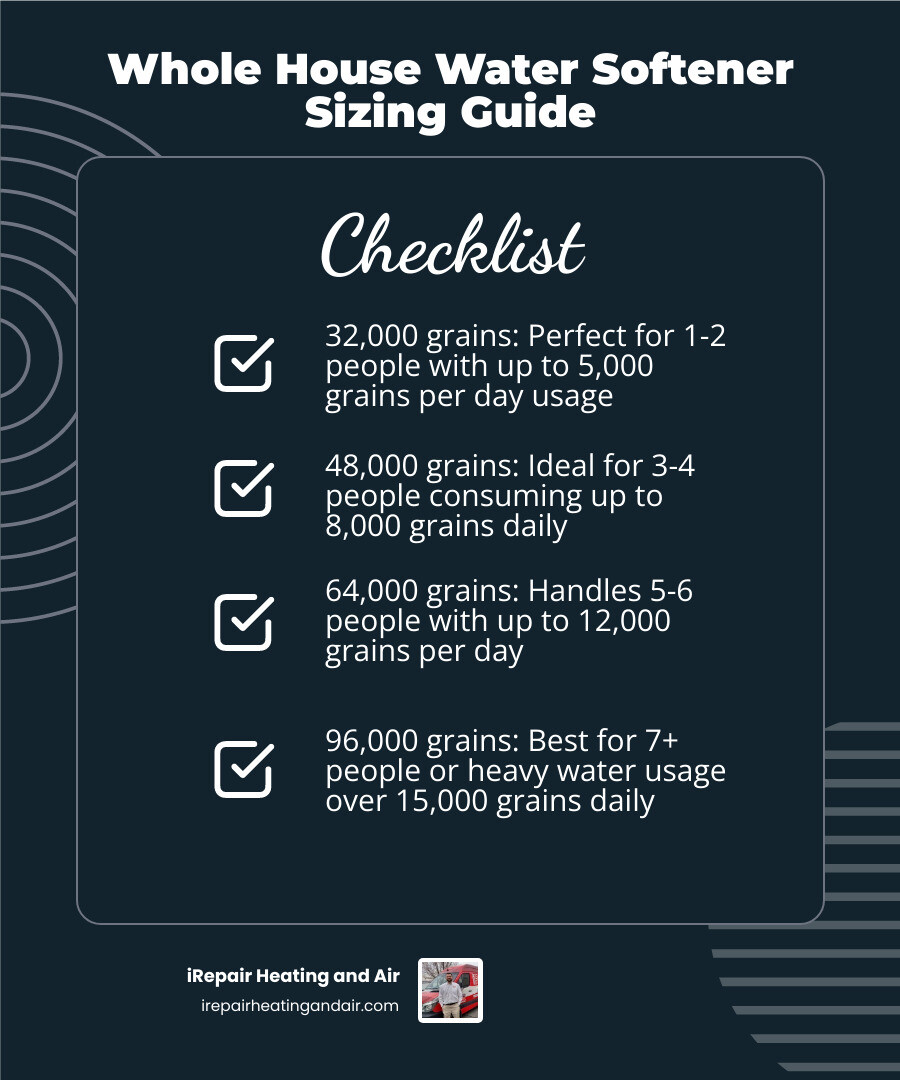
Bigger is not always better. Oversized systems cost more upfront and may waste salt or water. Undersized systems regenerate too often and wear out faster. The goal is a system that matches your household's actual demand.
Capacity is measured in grains. A common rule of thumb is:
Many guides use about 70 to 100 gallons per person per day. A common planning example is 90 gallons per person.
Example:
That equals:
If you want several days of capacity before regeneration, a 24,000- to 32,000-grain system may fit. If hardness is higher, or the family is larger, a 48,000- to 64,000-grain unit may make more sense.
| Household Size | Typical Capacity Range |
|---|---|
| 1-2 people | 24,000 - 32,000 grains |
| 3-4 people | 32,000 - 48,000 grains |
| 5+ people | 48,000 - 64,000+ grains |
In many Wasatch Front homes, hard water levels push us toward larger capacities than homeowners first expect. If you also want to protect a tankless water heater, sizing matters even more. We cover that in our guide to managing hard water in tankless systems.
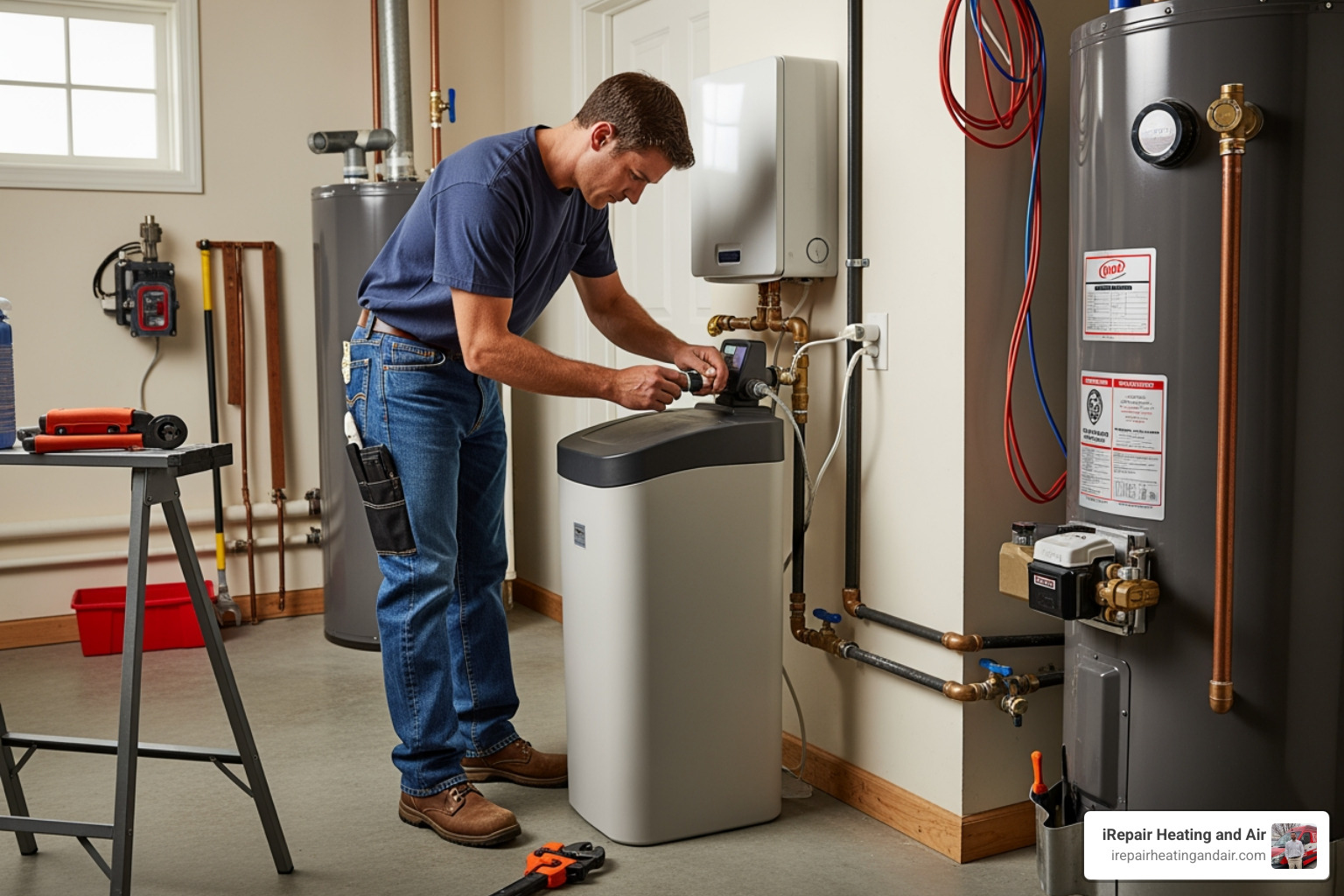
The softener itself is only part of the bill. The real wildcard is what it takes to connect it properly.
Costs increase when we need to deal with:
Permit costs often range around $200 to $500 where required, though local rules vary. Electrical work may be minor if a nearby outlet already exists, or more expensive if one must be added. Plumbing modifications can range from minimal to significant depending on pipe material and layout.
Drainage is another detail people miss. Softeners need a safe discharge point for regeneration. If overflow and drain planning are done poorly, you can end up with leaks, backups, or a surprise puddle party in the utility room. For more on that, see our water softener overflow drain guide.
Not every "water softener" works the same way, and not every lower sticker price is actually a better value.
The main options are:
For a broader national pricing reference, this 2026 water softener cost guide is a useful comparison point.
Salt-based ion exchange systems are still the standard choice for true softening. They remove hardness minerals like calcium and magnesium and replace them with sodium or potassium ions. They work very well in hard-water areas like ours.
Typical installed cost:
Ongoing costs:
Salt-free systems are better described as conditioners. They usually do not remove hardness minerals. Instead, they help reduce scale formation using media such as TAC technology. That means lower maintenance, but also different performance. In very hard water, they may not give the same results as a true softener.
Typical installed cost:
Ongoing costs:
Potassium chloride can also be used in some ion-exchange systems instead of sodium chloride, but it costs much more. A 40-pound bag of salt often runs $5 to $10, while potassium may run $50 to $70.
Magnetic or electronic systems are the cheapest upfront, usually around $200 to $600, but their real-world effectiveness is debated. We usually tell homeowners to be cautious here. Low price is great, but not if the scale on your fixtures laughs and stays put.
Dual-tank systems cost more, but they shine in larger households or homes with very hard water. One tank can regenerate while the other keeps delivering softened water, so you do not lose soft water during regeneration.
Typical installed cost:
These systems make sense when you have:
If your setup is outdoors or you are comparing more advanced configurations, our guide to twin-tank and outdoor water softener installation goes deeper.
Reverse osmosis is a different category. Whole-home reverse osmosis systems provide very high filtration but are expensive and not the default choice for most homes needing only hardness treatment.
Typical installed cost:
DIY installation looks cheaper on paper. Sometimes it is. But only when everything goes right.
If you buy the unit yourself and handle the install, you may save roughly $150 to $1,000 in labor. Materials for a simple install may only add a modest amount. For a homeowner with the right plumbing skills, existing loop, nearby drain, and no code complications, DIY can work.
But there are real risks:
Research consistently shows that DIY can save a few hundred dollars upfront, but installation mistakes can create $500 to $1,500 or more in repair costs. That is a rough trade if the "savings" later become an insurance deductible and a soggy drywall project.
Professional installation is usually worth it when:
If you are shopping around, our guide on how to hire the best local water softener installers can help you compare quotes the smart way.
The upfront install price gets all the attention, but ongoing cost matters too. A system that seems cheap on day one may be more expensive over 10 years.
Typical recurring costs include:
Most resin beds last around 8 to 10 years, though some systems may go longer. Filters and pre-filters need replacement on schedule. Salt-based systems need regular refill checks, typically every few months depending on usage.
Some national estimates also mention energy costs, especially for more complex systems. For standard softeners, electricity use is usually modest, but it is still part of long-term ownership.
The good news is that softened water can reduce costs elsewhere:
Some sources estimate soft water can cut soap use by up to 50%. Others estimate total household savings can add up quickly over time. In hard-water areas, the value is not just comfort. It is prevention.
If you want to reduce upfront cost, check whether seasonal promotions are available through our water softener coupon page. For a broader national benchmark on maintenance and repairs, this 2026 installation cost data page is also useful.
Most quality water softeners last about 10 to 20 years. Some sources put the upper end closer to 25 years with excellent maintenance, while some single-tank electric models may last closer to 12 years.
Lifespan depends on:
Signs it may be time to replace the system include:
For many Utah homeowners, yes. Especially in areas with hard water, a softener helps protect plumbing, water heaters, dishwashers, washing machines, shower doors, and fixtures.
The benefits usually include:
Some industry estimates suggest households can save around $125 per month when you combine lower cleaning-product use, less scale damage, and better equipment efficiency. Actual savings vary, but the core point is solid: hard water is expensive in sneaky ways.
Usually, not much. Ion-exchange softeners can add a small amount of sodium to water. One estimate puts it around 12 to 25 mg per 8-ounce glass for moderately hard water. For most people, that is not a major concern.
Still, if anyone in the home is on a strict sodium-restricted diet, you have options:
That last option is common in homes that want whole-house appliance protection without softening every sip.
The easiest way to cut whole house water softener installation cost is not to buy the cheapest box online and hope for the best. It is to choose the right system size, avoid unnecessary upgrades, and get the installation done correctly the first time. That means fewer repairs, better performance, and a system that actually solves your hard water problem instead of becoming one.
At iRepair Heating and Air, we help homeowners across Salt Lake City, Ogden, Provo, Park City, and the Wasatch Front choose water softeners that fit their home, plumbing, and budget. Whether you need a basic salt-based system or a more advanced setup, we can help you understand the real cost before work begins.
If you want help comparing options or getting a clear quote, learn more about our plumbing services in Salt Lake City.
