
Call 801-233-1564
Serving Salt Lake • Ogden • Provo • Park City
Licensed Contractor
Hot water tank element replacement is one of the most common — and most fixable — electric water heater problems homeowners face. Before you call a plumber or shop for a new tank, here's the quick answer:
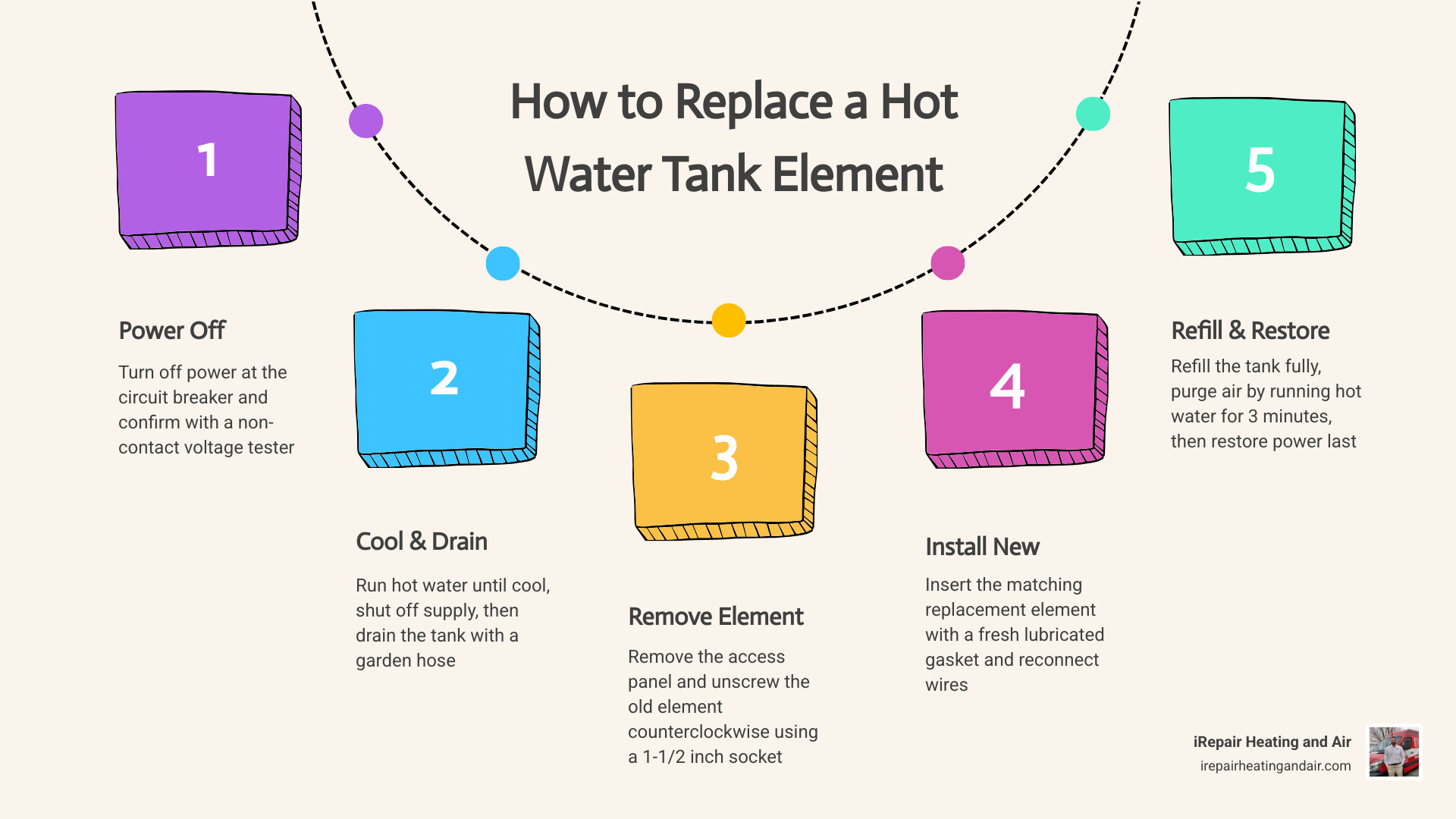
How to replace a water heater element (quick overview):
Most homeowners can complete this job in 2–3 hours with basic tools, spending as little as $8–$72 on the element alone — or $35–$42 for a full tune-up kit.
Sound familiar? You step into the shower expecting warm water and get a cold surprise instead. Or your hot water runs out faster than it used to. These are classic signs that one of your tank's heating elements has called it quits — and with electric water heaters typically lasting 10–15 years, element burnout is something most Utah homeowners will deal with at least once.
The good news: this is a very doable DIY repair when you follow the right steps and take safety seriously. This guide walks you through everything — from spotting the symptoms to safely restoring hot water.
At iRepair Heating & Air, our team has diagnosed and repaired countless water heaters across Utah's Wasatch Front — including plenty of hot water tank element replacements that homeowners thought required a full unit swap. Read on and we'll help you handle this the right way.
Hot water tank element replacement terms to remember:
A bad heating element does not always announce itself dramatically. Sometimes it is subtle. Sometimes it is more like your shower suddenly betraying you at 6:30 a.m.
Electric tank water heaters usually have one or two elements. In most homes, the upper and lower elements do different jobs. The upper element helps with recovery, while the lower element maintains the bulk of the hot water supply. That is why the symptoms can vary depending on which one fails.
Here are the most common clues:
In practical terms:
Sediment is a major troublemaker in Utah. Hard water can coat the lower element, forcing it to overwork until it burns out. If your tank has been making popcorn-like noises, that buildup may be part of the problem.
Before starting a hot water tank element replacement, confirm the element is the issue and not the thermostat, wiring, or breaker.
A basic multimeter test helps:
A healthy element commonly reads in roughly the 5-25 ohm range, though many good residential elements land around 10-30 ohms depending on wattage. If the meter shows infinity or no continuity, the element is open and likely failed.
Also test for a grounded element:
You should not get continuity there. If you do, the element is shorted to ground and needs replacement.
If the element tests okay, inspect:
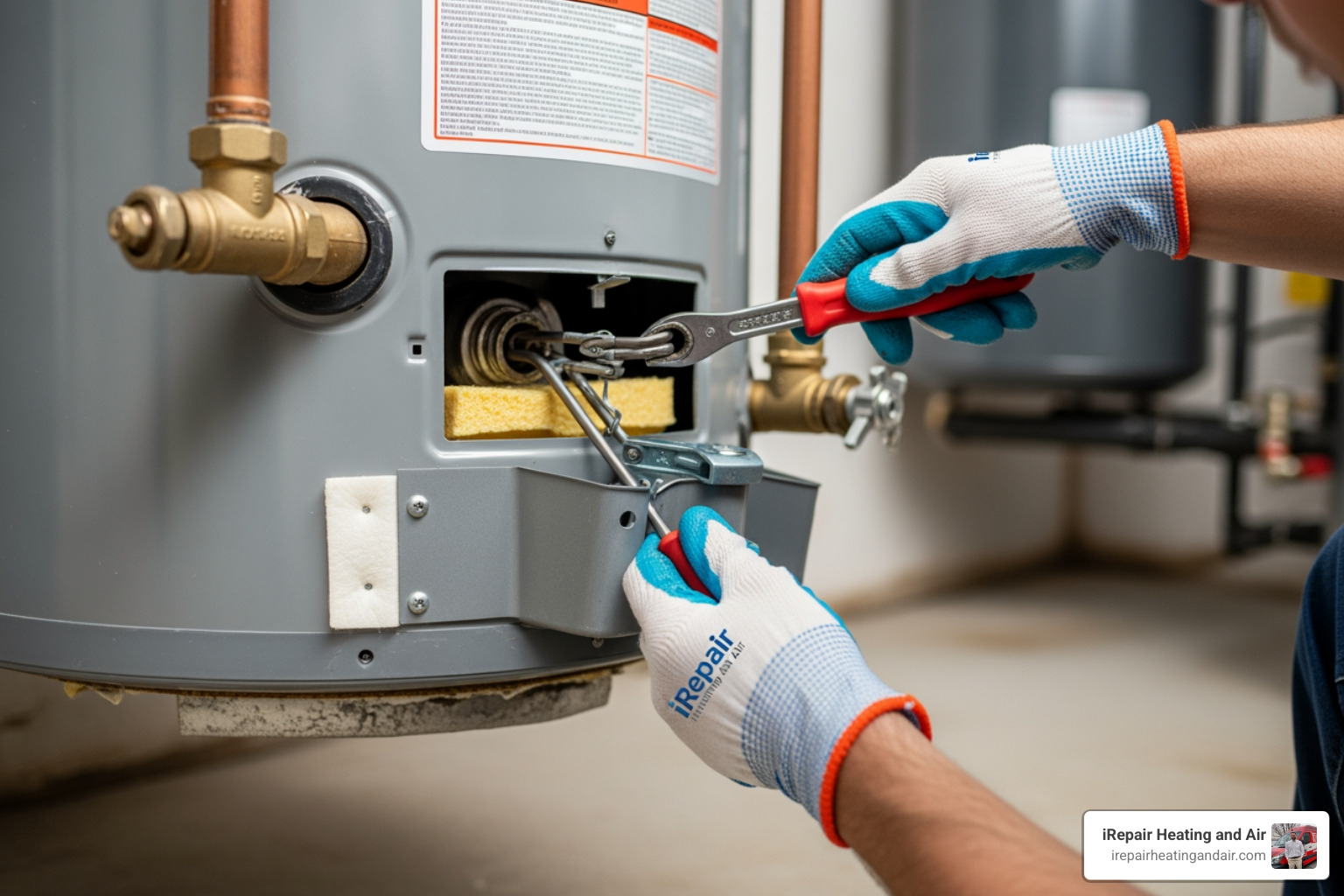
Getting the right part matters just as much as knowing the steps. Wrong wattage, wrong length, wrong gasket, wrong style - that is how a simple repair becomes a sequel nobody asked for.
For most jobs, we recommend having these on hand:
Nice to have:
A full tune-up kit often includes two elements, thermostats, and gaskets. Research shows those kits commonly run $35-$42, which can be a smart buy if your heater is older and uses two elements.
Always match the replacement to the heater's data plate and the old part.
Check these details:
Important rule: never upsize the wattage just because a bigger number sounds better. If the heater is rated for 4500W, do not install a 5500W element unless the manufacturer specifically allows it. Higher wattage can overload wiring and thermostats.
If you are unsure, take a photo of:
Then match from that.
Here is the plain-English version:
| Element type | Best use | Pros | Watch-outs |
|---|---|---|---|
| High-watt density | Standard replacement in many residential tanks | Common, affordable, heats quickly | More vulnerable to scale in hard water |
| Low-watt density | Hard water areas like much of Utah | Better resistance to lime buildup, can last longer | Usually costs a bit more |
| Fold-back | Tanks with limited clearance or specific OEM designs | Compact shape, useful where straight elements do not fit well | Must match tank compatibility |
| Straight hairpin | Common in many double-element heaters | Widely available, simple design | Needs enough internal clearance |
For many Wasatch Front homes with mineral-heavy water, low-watt density elements can be a solid upgrade if they match the heater specs.
Typical 2026 pricing looks like this:
Lower-cost standard elements are common, while specialty materials and premium designs cost more.
You can usually find replacement parts at:
There is no shortage of options. Online retailers list thousands of water heater element products, and major home improvement stores carry many common sizes. Just do not let "close enough" talk you into the wrong part.
Now for the main event. These steps apply to most residential electric tank water heaters.
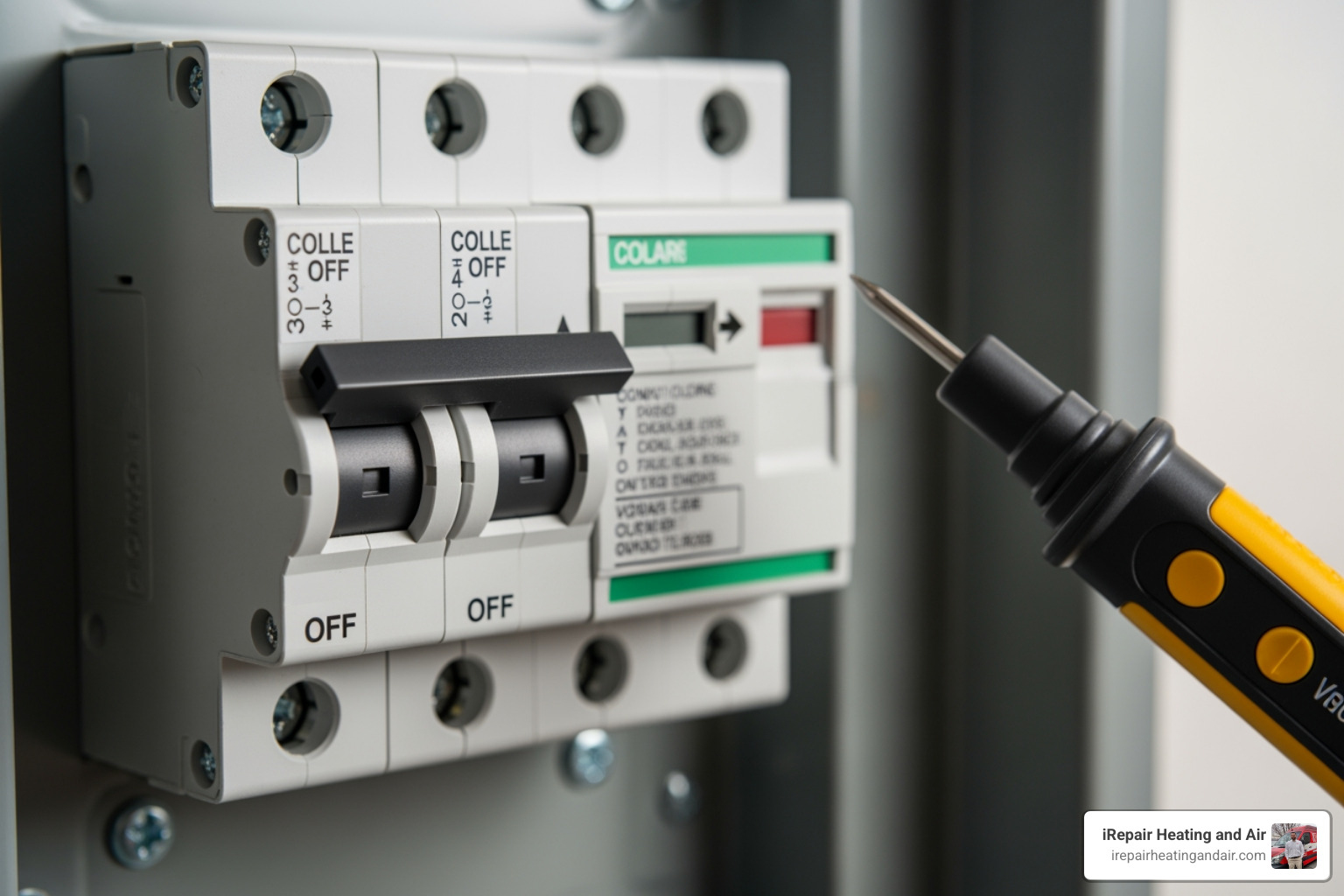
Before any hot water tank element replacement, slow down and make the area safe.
Do this first:
Two hazards matter most here:
And one expensive mistake matters almost as much:
If you are not comfortable working around 240 volts, stop here and call a pro.
Most element replacement jobs require draining the tank below the level of the element being changed. For a lower element, that often means a near-complete drain.
If the flow is weak, sediment may be clogging the drain. Sometimes briefly opening the pressure relief path or working the drain carefully helps. Manufacturer-style guidance like Replace the Heating Element also emphasizes cooling the water first and draining fully before removal.
Once drained:
This can take some force. Old elements may be stuck from scale or corrosion. Apply steady pressure, not wild acrobatics.
After removal:
If the tank threads are damaged or the element opening is badly corroded, DIY may no longer be the best plan.
Once the opening is clean:
Do not overtighten. Snug and sealed is the goal. "Crush the tank with heroic enthusiasm" is not.
Next:
When water runs in a smooth full stream from the hot faucet, air is being purged. Many manufacturer instructions recommend running the hot water for 3 minutes after refill to remove all trapped air and prevent dry fire damage.
Then:
Expect the tank to take some time to heat up again. Depending on size and element wattage, full reheating can take up to 2 hours.
For more manufacturer-style walk-throughs, see Replace the Lower Heating Element and this technical reference on electric water heater heating element replacement.
A lot of water heater repairs go wrong for very predictable reasons. The good news: predictable mistakes are avoidable.
Watch out for these:
That first one is the biggest. A dry-fired element can burn out almost instantly. One minute old, already dead. That is a tough résumé.
Sometimes the element is not the real problem. Or not the only problem.
Call for professional help if you find:
If your tank is older and having multiple issues, replacement may be smarter than repair. We break that down in The Ultimate Breakdown of Water Heater Replacement Costs.
And if you want to reduce future element failures, regular flushing and maintenance matter. Start here: How to Maintain Your Water Heater Tank Without Getting Burned.
For first-timers, usually 2-3 hours. Drain time, removal difficulty, sediment, and refill time all affect the schedule. After power is restored, the tank may need up to 2 hours to heat fully again.
Yes. If only one element tests bad, you can replace just that one. But on an older two-element heater, a full tune-up kit may make sense if both elements and thermostats are original. It can save time and help prevent round two next month.
Then the issue may be:
At that point, more diagnosis is needed. This technical guide on electric water heater heating element replacement procedure covers some advanced troubleshooting, but if you are chasing electrical faults, we recommend calling a licensed pro.
A successful hot water tank element replacement comes down to three things: the right diagnosis, the right part, and the discipline to keep the tank full before restoring power. If you follow the process carefully, this is a very manageable repair for many homeowners.
If you would rather skip the breaker panel, the hose wrestling, and the "is that drip normal?" phase, we can help. At iRepair Heating & Air, we provide same-day emergency service, fair pricing, and family-owned local care across Salt Lake, Ogden, Provo, Park City, and the Wasatch Front.
Need help with a stubborn element, thermostat issue, or a full tank replacement? Explore our local plumbing services, learn more about water heater installation, or check out our water heater maintenance services.
If your water heater is acting up, we are here to help you get back to hot showers and normal mornings.